## Issue Addressed

Closes https://github.com/sigp/lighthouse/issues/2327

## Proposed Changes

This is an extension of some ideas I implemented while working on `tree-states`:

- Cache the indexed attestations from blocks in the `ConsensusContext`. Previously we were re-computing them 3-4 times over.
- Clean up `import_block` by splitting each part into `import_block_XXX`.
- Move some stuff off hot paths, specifically:
  - Relocate non-essential tasks that were running between receiving the payload verification status and priming the early attester cache. These tasks are moved after the cache priming:
    - Attestation observation
    - Validator monitor updates
    - Slasher updates
    - Updating the shuffling cache
  - Fork choice attestation observation now happens at the end of block verification in parallel with payload verification (this seems to save 5-10ms).
  - Payload verification now happens _before_ advancing the pre-state and writing it to disk! States were previously being written eagerly and adding ~20-30ms in front of verifying the execution payload. State catchup also sometimes takes ~500ms if we get a cache miss and need to rebuild the tree hash cache.

The remaining task that's taking substantial time (~20ms) is importing the block to fork choice. I _think_ this is because of pull-tips, and we should be able to optimise it out with a clever total active balance cache in the state (which would be computed in parallel with payload verification). I've decided to leave that for future work though. For now it can be observed via the new `beacon_block_processing_post_exec_pre_attestable_seconds` metric.


Co-authored-by: Michael Sproul <micsproul@gmail.com>
## Issue Addressed

#3704

## Proposed Changes
Adds is_syncing_finalized: bool parameter for block verification functions. Sets the payload_verification_status to Optimistic if is_syncing_finalized is true. Uses SyncState in NetworkGlobals in BeaconProcessor to retrieve the syncing status.

## Additional Info
I could implement FinalizedSignatureVerifiedBlock if you think it would be nicer.
## Summary
The deposit cache now has the ability to finalize deposits. This will cause it to drop unneeded deposit logs and hashes in the deposit Merkle tree that are no longer required to construct deposit proofs. The cache is finalized whenever the latest finalized checkpoint has a new `Eth1Data` with all deposits imported.
This has three benefits:
1. Improves the speed of constructing Merkle proofs for deposits as we can just replay deposits since the last finalized checkpoint instead of all historical deposits when re-constructing the Merkle tree.
2. Significantly faster weak subjectivity sync as the deposit cache can be transferred to the newly syncing node in compressed form. The Merkle tree that stores `N` finalized deposits requires a maximum of `log2(N)` hashes. The newly syncing node then only needs to download deposits since the last finalized checkpoint to have a full tree.
3. Future proofing in preparation for [EIP-4444](https://eips.ethereum.org/EIPS/eip-4444) as execution nodes will no longer be required to store logs permanently so we won't always have all historical logs available to us.
## More Details
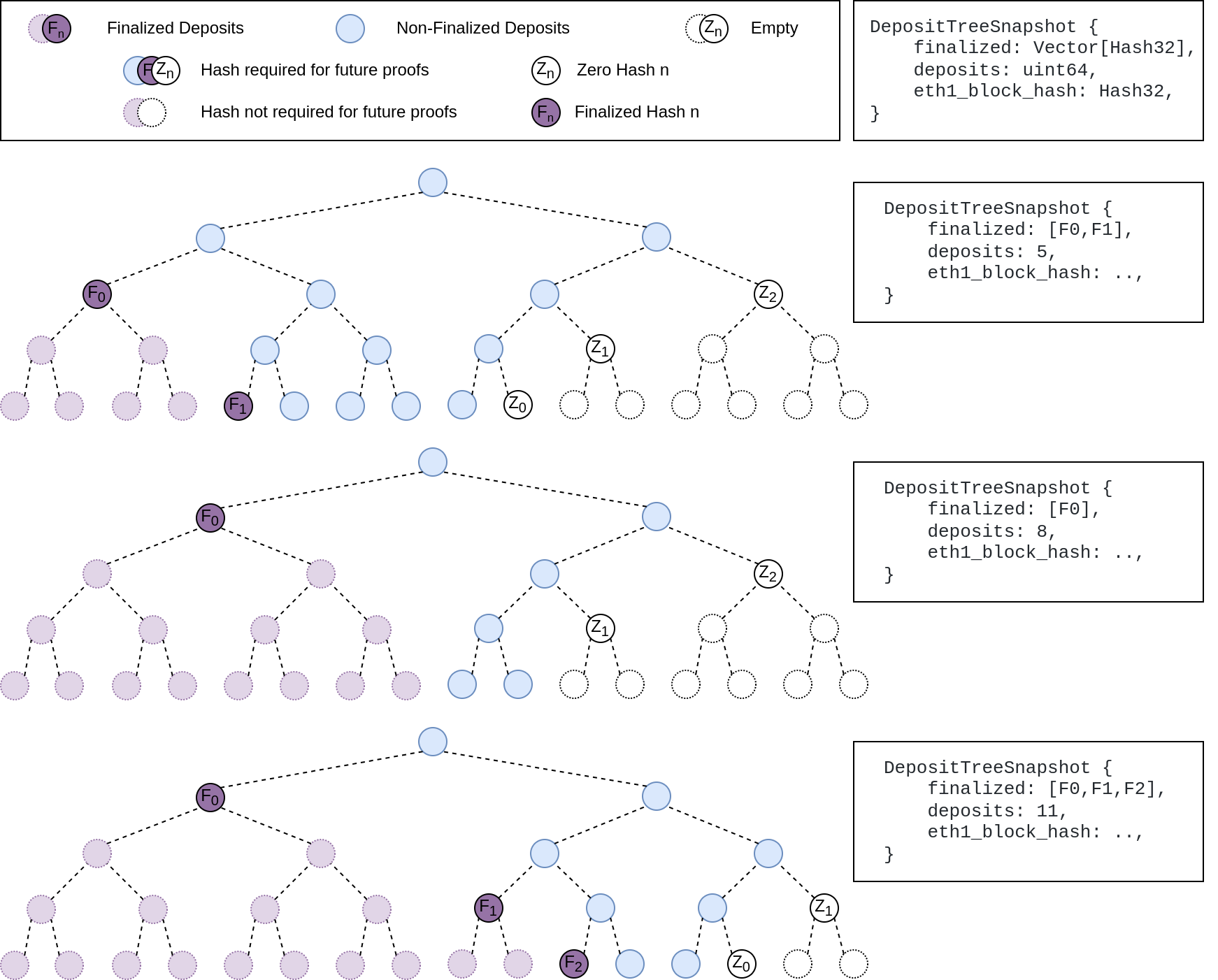
Image to illustrate how the deposit contract merkle tree evolves and finalizes along with the resulting `DepositTreeSnapshot`
## Other Considerations
I've changed the structure of the `SszDepositCache` so once you load & save your database from this version of lighthouse, you will no longer be able to load it from older versions.
Co-authored-by: ethDreamer <37123614+ethDreamer@users.noreply.github.com>
* add capella gossip boiler plate

* get everything compiling

Co-authored-by: realbigsean <sean@sigmaprime.io
Co-authored-by: Mark Mackey <mark@sigmaprime.io>

* small cleanup

* small cleanup

* cargo fix + some test cleanup

* improve block production

* add fixme for potential panic

Co-authored-by: Mark Mackey <mark@sigmaprime.io>
## Issue Addressed

Closes https://github.com/sigp/lighthouse/issues/2371

## Proposed Changes

Backport some changes from `tree-states` that remove duplicated calculations of the `proposer_index`.

With this change the proposer index should be calculated only once for each block, and then plumbed through to every place it is required.

## Additional Info

In future I hope to add more data to the consensus context that is cached on a per-epoch basis, like the effective balances of validators and the base rewards.

There are some other changes to remove indexing in tests that were also useful for `tree-states` (the `tree-states` types don't implement `Index`).
## Issue Addressed

NA

## Proposed Changes

This PR removes duplicated block root computation.

Computing the `SignedBeaconBlock::canonical_root` has become more expensive since the merge as we need to compute the merke root of each transaction inside an `ExecutionPayload`.

Computing the root for [a mainnet block](https://beaconcha.in/slot/4704236) is taking ~10ms on my i7-8700K CPU @ 3.70GHz (no sha extensions). Given that our median seen-to-imported time for blocks is presently 300-400ms, removing a few duplicated block roots (~30ms) could represent an easy 10% improvement. When we consider that the seen-to-imported times include operations *after* the block has been placed in the early attester cache, we could expect the 30ms to be more significant WRT our seen-to-attestable times.

## Additional Info

NA
## Proposed Changes

This PR has two aims: to speed up attestation packing in the op pool, and to fix bugs in the verification of attester slashings, proposer slashings and voluntary exits. The changes are bundled into a single database schema upgrade (v12).

Attestation packing is sped up by removing several inefficiencies:

- No more recalculation of `attesting_indices` during packing.
- No (unnecessary) examination of the `ParticipationFlags`: a bitfield suffices. See `RewardCache`.
- No re-checking of attestation validity during packing: the `AttestationMap` provides attestations which are "correct by construction" (I have checked this using Hydra).
- No SSZ re-serialization for the clunky `AttestationId` type (it can be removed in a future release).

So far the speed-up seems to be roughly 2-10x, from 500ms down to 50-100ms.

Verification of attester slashings, proposer slashings and voluntary exits is fixed by:

- Tracking the `ForkVersion`s that were used to verify each message inside the `SigVerifiedOp`. This allows us to quickly re-verify that they match the head state's opinion of what the `ForkVersion` should be at the epoch(s) relevant to the message.
- Storing the `SigVerifiedOp` on disk rather than the raw operation. This allows us to continue track the fork versions after a reboot.

This is mostly contained in this commit 52bb1840ae.

## Additional Info

The schema upgrade uses the justified state to re-verify attestations and compute `attesting_indices` for them. It will drop any attestations that fail to verify, by the logic that attestations are most valuable in the few slots after they're observed, and are probably stale and useless by the time a node restarts. Exits and proposer slashings and similarly re-verified to obtain `SigVerifiedOp`s.

This PR contains a runtime killswitch `--paranoid-block-proposal` which opts out of all the optimisations in favour of closely verifying every included message. Although I'm quite sure that the optimisations are correct this flag could be useful in the event of an unforeseen emergency.

Finally, you might notice that the `RewardCache` appears quite useless in its current form because it is only updated on the hot-path immediately before proposal. My hope is that in future we can shift calls to `RewardCache::update` into the background, e.g. while performing the state advance. It is also forward-looking to `tree-states` compatibility, where iterating and indexing `state.{previous,current}_epoch_participation` is expensive and needs to be minimised.
## Issue Addressed

Closes https://github.com/sigp/lighthouse/issues/2962

## Proposed Changes

Build all caches on the checkpoint state before storing it in the database.

Additionally, fix a bug in `signature_verify_chain_segment` which prevented block verification from succeeding unless the previous epoch cache was already built. The previous epoch cache is required to verify the signatures of attestations included from previous epochs, even when all the blocks in the segment are from the same epoch.

The comments around `signature_verify_chain_segment` have also been updated to reflect the fact that it should only be used on a chain of blocks from a single epoch. I believe this restriction had already been added at some point in the past and that the current comments were just outdated (and I think because the proposer shuffling can change in the next epoch based on the blocks applied in the current epoch that this limitation is essential).
## Issue Addressed

Add a flag that optionally enables unrealized vote tracking.  Would like to test out on testnets and benchmark differences in methods of vote tracking. This PR includes a DB schema upgrade to enable to new vote tracking style.


Co-authored-by: realbigsean <sean@sigmaprime.io>
Co-authored-by: Paul Hauner <paul@paulhauner.com>
Co-authored-by: sean <seananderson33@gmail.com>
Co-authored-by: Mac L <mjladson@pm.me>
## Issue Addressed
* #3344

## Proposed Changes

There are a number of cases during block processing where we might get an `ExecutionPayloadError` but we shouldn't penalize peers. We were forgetting to enumerate all of the non-penalizing errors in every single match statement where we are making that decision. I created a function to make it explicit when we should and should not penalize peers and I used that function in all places where this logic is needed. This way we won't make the same mistake if we add another variant of `ExecutionPayloadError` in the future.
## Overview

This rather extensive PR achieves two primary goals:

1. Uses the finalized/justified checkpoints of fork choice (FC), rather than that of the head state.
2. Refactors fork choice, block production and block processing to `async` functions.

Additionally, it achieves:

- Concurrent forkchoice updates to the EL and cache pruning after a new head is selected.
- Concurrent "block packing" (attestations, etc) and execution payload retrieval during block production.
- Concurrent per-block-processing and execution payload verification during block processing.
- The `Arc`-ification of `SignedBeaconBlock` during block processing (it's never mutated, so why not?):
    - I had to do this to deal with sending blocks into spawned tasks.
    - Previously we were cloning the beacon block at least 2 times during each block processing, these clones are either removed or turned into cheaper `Arc` clones.
    - We were also `Box`-ing and un-`Box`-ing beacon blocks as they moved throughout the networking crate. This is not a big deal, but it's nice to avoid shifting things between the stack and heap.
    - Avoids cloning *all the blocks* in *every chain segment* during sync.
    - It also has the potential to clean up our code where we need to pass an *owned* block around so we can send it back in the case of an error (I didn't do much of this, my PR is already big enough 😅)
- The `BeaconChain::HeadSafetyStatus` struct was removed. It was an old relic from prior merge specs.

For motivation for this change, see https://github.com/sigp/lighthouse/pull/3244#issuecomment-1160963273

## Changes to `canonical_head` and `fork_choice`

Previously, the `BeaconChain` had two separate fields:

```
canonical_head: RwLock<Snapshot>,
fork_choice: RwLock<BeaconForkChoice>
```

Now, we have grouped these values under a single struct:

```
canonical_head: CanonicalHead {
  cached_head: RwLock<Arc<Snapshot>>,
  fork_choice: RwLock<BeaconForkChoice>
}
```

Apart from ergonomics, the only *actual* change here is wrapping the canonical head snapshot in an `Arc`. This means that we no longer need to hold the `cached_head` (`canonical_head`, in old terms) lock when we want to pull some values from it. This was done to avoid deadlock risks by preventing functions from acquiring (and holding) the `cached_head` and `fork_choice` locks simultaneously.

## Breaking Changes

### The `state` (root) field in the `finalized_checkpoint` SSE event

Consider the scenario where epoch `n` is just finalized, but `start_slot(n)` is skipped. There are two state roots we might in the `finalized_checkpoint` SSE event:

1. The state root of the finalized block, which is `get_block(finalized_checkpoint.root).state_root`.
4. The state root at slot of `start_slot(n)`, which would be the state from (1), but "skipped forward" through any skip slots.

Previously, Lighthouse would choose (2). However, we can see that when [Teku generates that event](de2b2801c8/data/beaconrestapi/src/main/java/tech/pegasys/teku/beaconrestapi/handlers/v1/events/EventSubscriptionManager.java (L171-L182)) it uses [`getStateRootFromBlockRoot`](de2b2801c8/data/provider/src/main/java/tech/pegasys/teku/api/ChainDataProvider.java (L336-L341)) which uses (1).

I have switched Lighthouse from (2) to (1). I think it's a somewhat arbitrary choice between the two, where (1) is easier to compute and is consistent with Teku.

## Notes for Reviewers

I've renamed `BeaconChain::fork_choice` to `BeaconChain::recompute_head`. Doing this helped ensure I broke all previous uses of fork choice and I also find it more descriptive. It describes an action and can't be confused with trying to get a reference to the `ForkChoice` struct.

I've changed the ordering of SSE events when a block is received. It used to be `[block, finalized, head]` and now it's `[block, head, finalized]`. It was easier this way and I don't think we were making any promises about SSE event ordering so it's not "breaking".

I've made it so fork choice will run when it's first constructed. I did this because I wanted to have a cached version of the last call to `get_head`. Ensuring `get_head` has been run *at least once* means that the cached values doesn't need to wrapped in an `Option`. This was fairly simple, it just involved passing a `slot` to the constructor so it knows *when* it's being run. When loading a fork choice from the store and a slot clock isn't handy I've just used the `slot` that was saved in the `fork_choice_store`. That seems like it would be a faithful representation of the slot when we saved it.

I added the `genesis_time: u64` to the `BeaconChain`. It's small, constant and nice to have around.

Since we're using FC for the fin/just checkpoints, we no longer get the `0x00..00` roots at genesis. You can see I had to remove a work-around in `ef-tests` here: b56be3bc2. I can't find any reason why this would be an issue, if anything I think it'll be better since the genesis-alias has caught us out a few times (0x00..00 isn't actually a real root). Edit: I did find a case where the `network` expected the 0x00..00 alias and patched it here: 3f26ac3e2.

You'll notice a lot of changes in tests. Generally, tests should be functionally equivalent. Here are the things creating the most diff-noise in tests:
- Changing tests to be `tokio::async` tests.
- Adding `.await` to fork choice, block processing and block production functions.
- Refactor of the `canonical_head` "API" provided by the `BeaconChain`. E.g., `chain.canonical_head.cached_head()` instead of `chain.canonical_head.read()`.
- Wrapping `SignedBeaconBlock` in an `Arc`.
- In the `beacon_chain/tests/block_verification`, we can't use the `lazy_static` `CHAIN_SEGMENT` variable anymore since it's generated with an async function. We just generate it in each test, not so efficient but hopefully insignificant.

I had to disable `rayon` concurrent tests in the `fork_choice` tests. This is because the use of `rayon` and `block_on` was causing a panic.

Co-authored-by: Mac L <mjladson@pm.me>
## Proposed Changes

Add a new HTTP endpoint `POST /lighthouse/analysis/block_rewards` which takes a vec of `BeaconBlock`s as input and outputs the `BlockReward`s for them.

Augment the `BlockReward` struct with the attestation data for attestations in the block, which simplifies access to this information from blockprint. Using attestation data I've been able to make blockprint up to 95% accurate across Prysm/Lighthouse/Teku/Nimbus. I hope to go even higher using a bunch of synthetic blocks produced for Prysm/Nimbus/Lodestar, which are underrepresented in the current training data.
## Issue Addressed

This fixes the low-hanging Clippy lints introduced in Rust 1.61 (due any hour now). It _ignores_ one lint, because fixing it requires a structural refactor of the validator client that needs to be done delicately. I've started on that refactor and will create another PR that can be reviewed in more depth in the coming days. I think we should merge this PR in the meantime to unblock CI.
## Proposed Changes

Reduce post-merge disk usage by not storing finalized execution payloads in Lighthouse's database.

⚠️ **This is achieved in a backwards-incompatible way for networks that have already merged** ⚠️. Kiln users and shadow fork enjoyers will be unable to downgrade after running the code from this PR. The upgrade migration may take several minutes to run, and can't be aborted after it begins.

The main changes are:

- New column in the database called `ExecPayload`, keyed by beacon block root.
- The `BeaconBlock` column now stores blinded blocks only.
- Lots of places that previously used full blocks now use blinded blocks, e.g. analytics APIs, block replay in the DB, etc.
- On finalization:
    - `prune_abanonded_forks` deletes non-canonical payloads whilst deleting non-canonical blocks.
    - `migrate_db` deletes finalized canonical payloads whilst deleting finalized states.
- Conversions between blinded and full blocks are implemented in a compositional way, duplicating some work from Sean's PR #3134.
- The execution layer has a new `get_payload_by_block_hash` method that reconstructs a payload using the EE's `eth_getBlockByHash` call.
   - I've tested manually that it works on Kiln, using Geth and Nethermind.
   - This isn't necessarily the most efficient method, and new engine APIs are being discussed to improve this: https://github.com/ethereum/execution-apis/pull/146.
   - We're depending on the `ethers` master branch, due to lots of recent changes. We're also using a workaround for https://github.com/gakonst/ethers-rs/issues/1134.
- Payload reconstruction is used in the HTTP API via `BeaconChain::get_block`, which is now `async`. Due to the `async` fn, the `blocking_json` wrapper has been removed.
- Payload reconstruction is used in network RPC to serve blocks-by-{root,range} responses. Here the `async` adjustment is messier, although I think I've managed to come up with a reasonable compromise: the handlers take the `SendOnDrop` by value so that they can drop it on _task completion_ (after the `fn` returns). Still, this is introducing disk reads onto core executor threads, which may have a negative performance impact (thoughts appreciated).

## Additional Info

- [x] For performance it would be great to remove the cloning of full blocks when converting them to blinded blocks to write to disk. I'm going to experiment with a `put_block` API that takes the block by value, breaks it into a blinded block and a payload, stores the blinded block, and then re-assembles the full block for the caller.
- [x] We should measure the latency of blocks-by-root and blocks-by-range responses.
- [x] We should add integration tests that stress the payload reconstruction (basic tests done, issue for more extensive tests: https://github.com/sigp/lighthouse/issues/3159)
- [x] We should (manually) test the schema v9 migration from several prior versions, particularly as blocks have changed on disk and some migrations rely on being able to load blocks.

Co-authored-by: Paul Hauner <paul@paulhauner.com>
## Issue Addressed

Fix a panic due to misuse of the Tokio executor when processing a forkchoiceUpdated response. We were previously calling `process_invalid_execution_payload` from the async function `update_execution_engine_forkchoice_async`, which resulted in a panic because `process_invalid_execution_payload` contains a call to fork choice, which ultimately calls `block_on`.

An example backtrace can be found here: https://gist.github.com/michaelsproul/ac5da03e203d6ffac672423eaf52fb20

## Proposed Changes

Wrap the call to `process_invalid_execution_payload` in a `spawn_blocking` so that `block_on` is no longer called from an async context.

## Additional Info

- I've been thinking about how to catch bugs like this with static analysis (a new Clippy lint).
- The payload validation tests have been re-worked to support distinct responses from the mock EE for newPayload and forkchoiceUpdated. Three new tests have been added covering the `Invalid`, `InvalidBlockHash` and `InvalidTerminalBlock` cases.
- I think we need a bunch more tests of different legal and illegal variations
## Issue Addressed

NA

## Proposed Changes

Disallow the production of attestations and retrieval of unaggregated attestations when they reference an optimistic head. Add tests to this end.

I also moved `BeaconChain::produce_unaggregated_attestation_for_block` to the `BeaconChainHarness`. It was only being used during tests, so it's nice to stop pretending it's production code. I also needed something that could produce attestations to optimistic blocks in order to simulate scenarios where the justified checkpoint is determined invalid (if no one would attest to an optimistic block, we could never justify it and then flip it to invalid).

## Additional Info

- ~~Blocked on #3126~~
## Issue Addressed

NA

## Proposed Changes

- Adds more checks to prevent importing blocks atop parent with invalid execution payloads.
- Adds a test for these conditions.

## Additional Info

NA
## Issue Addressed

MEV boost compatibility

## Proposed Changes

See #2987

## Additional Info

This is blocked on the stabilization of a couple specs, [here](https://github.com/ethereum/beacon-APIs/pull/194) and [here](https://github.com/flashbots/mev-boost/pull/20).

Additional TODO's and outstanding questions

- [ ] MEV boost JWT Auth
- [ ] Will `builder_proposeBlindedBlock` return the revealed payload for the BN to propogate
- [ ] Should we remove `private-tx-proposals` flag and communicate BN <> VC with blinded blocks by default once these endpoints enter the beacon-API's repo? This simplifies merge transition logic.

Co-authored-by: realbigsean <seananderson33@gmail.com>
Co-authored-by: realbigsean <sean@sigmaprime.io>
## Issue Addressed

No issue, just updating merge ASCII art.

## Proposed Changes

Updating ASCII art for merge.

## Additional Info

Please provide any additional information. For example, future considerations
or information useful for reviewers.
## Description

This PR adds a single, trivial commit (f5d2b27d78) atop #2986 to resolve a tests compile error. The original author (@ethDreamer) is AFK so I'm getting this one merged ☺️

Please see #2986 for more information about the other, significant changes in this PR.


Co-authored-by: Mark Mackey <mark@sigmaprime.io>
Co-authored-by: ethDreamer <37123614+ethDreamer@users.noreply.github.com>
## Issue Addressed

NA

## Proposed Changes

Adds the functionality to allow blocks to be validated/invalidated after their import as per the [optimistic sync spec](https://github.com/ethereum/consensus-specs/blob/dev/sync/optimistic.md#how-to-optimistically-import-blocks). This means:

- Updating `ProtoArray` to allow flipping the `execution_status` of ancestors/descendants based on payload validity updates.
- Creating separation between `execution_layer` and the `beacon_chain` by creating a `PayloadStatus` struct.
- Refactoring how the `execution_layer` selects a `PayloadStatus` from the multiple statuses returned from multiple EEs.
- Adding testing framework for optimistic imports.
- Add `ExecutionBlockHash(Hash256)` new-type struct to avoid confusion between *beacon block roots* and *execution payload hashes*.
- Add `merge` to [`FORKS`](c3a793fd73/Makefile (L17)) in the `Makefile` to ensure we test the beacon chain with merge settings.
    - Fix some tests here that were failing due to a missing execution layer.

## TODO

- [ ] Balance tests

Co-authored-by: Mark Mackey <mark@sigmaprime.io>
## Issue Addressed

NA

## Proposed Changes

This PR extends #3018 to address my review comments there and add automated integration tests with Geth (and other implementations, in the future).

I've also de-duplicated the "unused port" logic by creating an  `common/unused_port` crate.

## Additional Info

I'm not sure if we want to merge this PR, or update #3018 and merge that. I don't mind, I'm primarily opening this PR to make sure CI works.


Co-authored-by: Mark Mackey <mark@sigmaprime.io>
## Issue Addressed
Closes#3014
## Proposed Changes
- Rename `receipt_root` to `receipts_root`
- Rename `execute_payload` to `notify_new_payload`
- This is slightly weird since we modify everything except the actual HTTP call to the engine API. That change is expected to be implemented in #2985 (cc @ethDreamer)
- Enable "random" tests for Bellatrix.
## Notes
This will break *partially* compatibility with Kintusgi testnets in order to gain compatibility with [Kiln](https://hackmd.io/@n0ble/kiln-spec) testnets. I think it will only break the BN APIs due to the `receipts_root` change, however it might have some other effects too.
Co-authored-by: Michael Sproul <micsproul@gmail.com>
## Issue Addressed

This PR fixes the unnecessary `WARN Single block lookup failed` messages described here:

https://github.com/sigp/lighthouse/pull/2866#issuecomment-1008442640

## Proposed Changes

Add a new cache to the `BeaconChain` that tracks the block roots of blocks from before finalization. These could be blocks from the canonical chain (which might need to be read from disk), or old pre-finalization blocks that have been forked out.

The cache also stores a set of block roots for in-progress single block lookups, which duplicates some of the information from sync's `single_block_lookups` hashmap:

a836e180f9/beacon_node/network/src/sync/manager.rs (L192-L196)

On a live node you can confirm that the cache is working by grepping logs for the message: `Rejected attestation to finalized block`.
## Issue Addressed

Successor to #2431

## Proposed Changes

* Add a `BlockReplayer` struct to abstract over the intricacies of calling `per_slot_processing` and `per_block_processing` while avoiding unnecessary tree hashing.
* Add a variant of the forwards state root iterator that does not require an `end_state`.
* Use the `BlockReplayer` when reconstructing states in the database. Use the efficient forwards iterator for frozen states.
* Refactor the iterators to remove `Arc<HotColdDB>` (this seems to be neater than making _everything_ an `Arc<HotColdDB>` as I did in #2431).

Supplying the state roots allow us to avoid building a tree hash cache at all when reconstructing historic states, which saves around 1 second flat (regardless of `slots-per-restore-point`). This is a small percentage of worst-case state load times with 200K validators and SPRP=2048 (~15s vs ~16s) but a significant speed-up for more frequent restore points: state loads with SPRP=32 should be now consistently <500ms instead of 1.5s (a ~3x speedup).

## Additional Info

Required by https://github.com/sigp/lighthouse/pull/2628
## Issue Addressed

N/A

## Proposed Changes

Changes required for the `merge-devnet-3`. Added some more non substantive renames on top of @realbigsean 's commit.
Note: this doesn't include the proposer boosting changes in kintsugi v3.

This devnet isn't running with the proposer boosting fork choice changes so if we are looking to merge https://github.com/sigp/lighthouse/pull/2822 into `unstable`, then I think we should just maintain this branch for the devnet temporarily.


Co-authored-by: realbigsean <seananderson33@gmail.com>
Co-authored-by: Paul Hauner <paul@paulhauner.com>
## Proposed Changes

In the event of a late block, keep the block in the snapshot cache by cloning it. This helps us process new blocks quickly in the event the late block was re-org'd.


Co-authored-by: Michael Sproul <michael@sigmaprime.io>


