## Issue Addressed

Addresses #4238

## Proposed Changes

- [x] Add tests for the scenarios
- [x] Use the fork of the attestation slot for signature verification.
## Issue Addressed

Addresses #4234

## Proposed Changes

- Skip withdrawals processing in an inconsistent state replay.
- Repurpose `StateRootStrategy`: rename to `StateProcessingStrategy` and always skip withdrawals if using `StateProcessingStrategy::Inconsistent`
- Add a test to reproduce the scenario


Co-authored-by: Jimmy Chen <jimmy@sigmaprime.io>
## Issue Addressed

This PR un-deprecates some commonly used test util functions, e.g. `extend_chain`. Most of these were deprecated in 2020 but some of us still found them quite convenient and they're still being used a lot. If there's no issue with using them, I think we should remove the "Deprecated" comment to avoid confusion.
* Update Engine API to Latest

* Get Mock EE Working

* Fix Mock EE

* Update Engine API Again

* Rip out get_blobs_bundle Stuff

* Fix Test Harness

* Fix Clippy Complaints

* Fix Beacon Chain Tests
* rename 4844 to deneb

* rename 4844 to deneb

* move excess data gas field

* get EF tests working

* fix ef tests lint

* fix the blob identifier ef test

* fix accessed files ef test script

* get beacon chain tests passing
* introduce availability pending block

* add intoavailableblock trait

* small fixes

* add 'gossip blob cache' and start to clean up processing and transition types

* shard memory blob cache

* Initial commit

* Fix after rebase

* Add gossip verification conditions

* cache cleanup

* general chaos

* extended chaos

* cargo fmt

* more progress

* more progress

* tons of changes, just tryna compile

* everything, everywhere, all at once

* Reprocess an ExecutedBlock on unavailable blobs

* Add sus gossip verification for blobs

* Merge stuff

* Remove reprocessing cache stuff

* lint

* Add a wrapper to allow construction of only valid `AvailableBlock`s

* rename blob arc list to blob list

* merge cleanuo

* Revert "merge cleanuo"

This reverts commit 5e98326878.

* Revert "Revert "merge cleanuo""

This reverts commit 3a4009443a.

* fix rpc methods

* move beacon block and blob to eth2/types

* rename gossip blob cache to data availability checker

* lots of changes

* fix some compilation issues

* fix compilation issues

* fix compilation issues

* fix compilation issues

* fix compilation issues

* fix compilation issues

* cargo fmt

* use a common data structure for block import types

* fix availability check on proposal import

* refactor the blob cache and split the block wrapper into two types

* add type conversion for signed block and block wrapper

* fix beacon chain tests and do some renaming, add some comments

* Partial processing (#4)

* move beacon block and blob to eth2/types

* rename gossip blob cache to data availability checker

* lots of changes

* fix some compilation issues

* fix compilation issues

* fix compilation issues

* fix compilation issues

* fix compilation issues

* fix compilation issues

* cargo fmt

* use a common data structure for block import types

* fix availability check on proposal import

* refactor the blob cache and split the block wrapper into two types

* add type conversion for signed block and block wrapper

* fix beacon chain tests and do some renaming, add some comments

* cargo update (#6)

---------

Co-authored-by: realbigsean <sean@sigmaprime.io>
Co-authored-by: realbigsean <seananderson33@gmail.com>
## Issue Addressed
Add support for ipv6 and dual stack in lighthouse.

## Proposed Changes
From an user perspective, now setting an ipv6 address, optionally configuring the ports should feel exactly the same as using an ipv4 address. If listening over both ipv4 and ipv6 then the user needs to:
- use the `--listen-address` two times (ipv4 and ipv6 addresses)
- `--port6` becomes then required
- `--discovery-port6` can now be used to additionally configure the ipv6 udp port

### Rough list of code changes
- Discovery:
  - Table filter and ip mode set to match the listening config.
  - Ipv6 address, tcp port and udp port set in the ENR builder
  - Reported addresses now check which tcp port to give to libp2p
- LH Network Service:
  - Can listen over Ipv6, Ipv4, or both. This uses two sockets. Using mapped addresses is disabled from libp2p and it's the most compatible option.
- NetworkGlobals:
  - No longer stores udp port since was not used at all. Instead, stores the Ipv4 and Ipv6 TCP ports.
- NetworkConfig:
  - Update names to make it clear that previous udp and tcp ports in ENR were Ipv4
  - Add fields to configure Ipv6 udp and tcp ports in the ENR
  - Include advertised enr Ipv6 address.
  - Add type to model Listening address that's either Ipv4, Ipv6 or both. A listening address includes the ip, udp port and tcp port.
- UPnP:
  - Kept only for ipv4
- Cli flags:
  - `--listen-addresses` now can take up to two values
  - `--port` will apply to ipv4 or ipv6 if only one listening address is given. If two listening addresses are given it will apply only to Ipv4.
  - `--port6` New flag required when listening over ipv4 and ipv6 that applies exclusively to Ipv6.
  - `--discovery-port` will now apply to ipv4 and ipv6 if only one listening address is given.
  - `--discovery-port6` New flag to configure the individual udp port of ipv6 if listening over both ipv4 and ipv6.
  - `--enr-udp-port` Updated docs to specify that it only applies to ipv4. This is an old behaviour.
  - `--enr-udp6-port` Added to configure the enr udp6 field.
  - `--enr-tcp-port` Updated docs to specify that it only applies to ipv4. This is an old behaviour.
  - `--enr-tcp6-port` Added to configure the enr tcp6 field.
  - `--enr-addresses` now can take two values.
  - `--enr-match` updated behaviour.
- Common:
  - rename `unused_port` functions to specify that they are over ipv4.
  - add functions to get unused ports over ipv6.
- Testing binaries
  - Updated code to reflect network config changes and unused_port changes.

## Additional Info

TODOs:
- use two sockets in discovery. I'll get back to this and it's on https://github.com/sigp/discv5/pull/160
- lcli allow listening over two sockets in generate_bootnodes_enr
- add at least one smoke flag for ipv6 (I have tested this and works for me)
- update the book
## Issue Addressed
Closes#3896Closes#3998Closes#3700
## Proposed Changes
- Optimise the calculation of withdrawals for payload attributes by avoiding state clones, avoiding unnecessary state advances and reading from the snapshot cache if possible.
- Use the execution layer's payload attributes cache to avoid re-calculating payload attributes. I actually implemented a new LRU cache just for withdrawals but it had the exact same key and most of the same data as the existing payload attributes cache, so I deleted it.
- Add a new SSE event that fires when payloadAttributes are calculated. This is useful for block builders, a la https://github.com/ethereum/beacon-APIs/issues/244.
- Add a new CLI flag `--always-prepare-payload` which forces payload attributes to be sent with every fcU regardless of connected proposers. This is intended for use by builders/relays.
For maximum effect, the flags I've been using to run Lighthouse in "payload builder mode" are:
```
--always-prepare-payload \
--prepare-payload-lookahead 12000 \
--suggested-fee-recipient 0x0000000000000000000000000000000000000000
```
The fee recipient is required so Lighthouse has something to pack in the payload attributes (it can be ignored by the builder). The lookahead causes fcU to be sent at the start of every slot rather than at 8s. As usual, fcU will also be sent after each change of head block. I think this combination is sufficient for builders to build on all viable heads. Often there will be two fcU (and two payload attributes) sent for the same slot: one sent at the start of the slot with the head from `n - 1` as the parent, and one sent after the block arrives with `n` as the parent.
Example usage of the new event stream:
```bash
curl -N "http://localhost:5052/eth/v1/events?topics=payload_attributes"
```
## Additional Info
- [x] Tests added by updating the proposer re-org tests. This has the benefit of testing the proposer re-org code paths with withdrawals too, confirming that the new changes don't interact poorly.
- [ ] Benchmarking with `blockdreamer` on devnet-7 showed promising results but I'm yet to do a comparison to `unstable`.
Co-authored-by: Michael Sproul <micsproul@gmail.com>
## Issue Addressed

Cleans up all the remnants of 4844 in capella. This makes sure when 4844 is reviewed there is nothing we are missing because it got included here

## Proposed Changes

drop a bomb on every 4844 thing

## Additional Info

Merge process I did (locally) is as follows:
- squash merge to produce one commit
- in new branch off unstable with the squashed commit create a `git revert HEAD` commit
- merge that new branch onto 4844 with `--strategy ours`
- compare local 4844 to remote 4844 and make sure the diff is empty
- enjoy

Co-authored-by: Paul Hauner <paul@paulhauner.com>
* Add first efforts at broadcast

* Tidy

* Move broadcast code to client

* Progress with broadcast impl

* Rename to address change

* Fix compile errors

* Use `while` loop

* Tidy

* Flip broadcast condition

* Switch to forgetting individual indices

* Always broadcast when the node starts

* Refactor into two functions

* Add testing

* Add another test

* Tidy, add more testing

* Tidy

* Add test, rename enum

* Rename enum again

* Tidy

* Break loop early

* Add V15 schema migration

* Bump schema version

* Progress with migration

* Update beacon_node/client/src/address_change_broadcast.rs

Co-authored-by: Michael Sproul <micsproul@gmail.com>

* Fix typo in function name

---------

Co-authored-by: Michael Sproul <micsproul@gmail.com>
* Use Local Payload if More Profitable than Builder

* Rename clone -> clone_from_ref

* Minimize Clones of GetPayloadResponse

* Cleanup & Fix Tests

* Added Tests for Payload Choice by Profit

* Fix Outdated Comments
* Use eth1_withdrawal_credential in Some Test States

* Update beacon_node/genesis/src/interop.rs

Co-authored-by: Michael Sproul <micsproul@gmail.com>

* Update beacon_node/genesis/src/interop.rs

Co-authored-by: Michael Sproul <micsproul@gmail.com>

* Increase validator sizes

* Pick next sync committee message

Co-authored-by: Michael Sproul <micsproul@gmail.com>
Co-authored-by: Paul Hauner <paul@paulhauner.com>
* Import BLS to execution changes before Capella

* Test for BLS to execution change HTTP API

* Pack BLS to execution changes in LIFO order

* Remove unused var

* Clippy
* Use eth1_withdrawal_credential in Some Test States

* Update beacon_node/genesis/src/interop.rs

Co-authored-by: Michael Sproul <micsproul@gmail.com>

* Update beacon_node/genesis/src/interop.rs

Co-authored-by: Michael Sproul <micsproul@gmail.com>

* Increase validator sizes

* Pick next sync committee message

Co-authored-by: Michael Sproul <micsproul@gmail.com>
Co-authored-by: Paul Hauner <paul@paulhauner.com>
* Import BLS to execution changes before Capella

* Test for BLS to execution change HTTP API

* Pack BLS to execution changes in LIFO order

* Remove unused var

* Clippy
## Issue Addressed

NA

## Proposed Changes

Myself and others (#3678) have observed  that when running with lots of validators (e.g., 1000s) the cardinality is too much for Prometheus. I've seen Prometheus instances just grind to a halt when we turn the validator monitor on for our testnet validators (we have 10,000s of Goerli validators). Additionally, the debug log volume can get very high with one log per validator, per attestation.

To address this, the `bn --validator-monitor-individual-tracking-threshold <INTEGER>` flag has been added to *disable* per-validator (i.e., non-aggregated) metrics/logging once the validator monitor exceeds the threshold of validators. The default value is `64`, which is a finger-to-the-wind value. I don't actually know the value at which Prometheus starts to become overwhelmed, but I've seen it work with ~64 validators and I've seen it *not* work with 1000s of validators. A default of `64` seems like it will result in a breaking change to users who are running millions of dollars worth of validators whilst resulting in a no-op for low-validator-count users. I'm open to changing this number, though.

Additionally, this PR starts collecting aggregated Prometheus metrics (e.g., total count of head hits across all validators), so that high-validator-count validators still have some interesting metrics. We already had logging for aggregated values, so nothing has been added there.

I've opted to make this a breaking change since it can be rather damaging to your Prometheus instance to accidentally enable the validator monitor with large numbers of validators. I've crashed a Prometheus instance myself and had a report from another user who's done the same thing.

## Additional Info

NA

## Breaking Changes Note

A new label has been added to the validator monitor Prometheus metrics: `total`. This label tracks the aggregated metrics of all validators in the validator monitor (as opposed to each validator being tracking individually using its pubkey as the label).

Additionally, a new flag has been added to the Beacon Node: `--validator-monitor-individual-tracking-threshold`. The default value is `64`, which means that when the validator monitor is tracking more than 64 validators then it will stop tracking per-validator metrics and only track the `all_validators` metric. It will also stop logging per-validator logs and only emit aggregated logs (the exception being that exit and slashing logs are always emitted).

These changes were introduced in #3728 to address issues with untenable Prometheus cardinality and log volume when using the validator monitor with high validator counts (e.g., 1000s of validators). Users with less than 65 validators will see no change in behavior (apart from the added `all_validators` metric). Users with more than 65 validators who wish to maintain the previous behavior can set something like `--validator-monitor-individual-tracking-threshold 999999`.
## Proposed Changes

With proposer boosting implemented (#2822) we have an opportunity to re-org out late blocks.

This PR adds three flags to the BN to control this behaviour:

* `--disable-proposer-reorgs`: turn aggressive re-orging off (it's on by default).
* `--proposer-reorg-threshold N`: attempt to orphan blocks with less than N% of the committee vote. If this parameter isn't set then N defaults to 20% when the feature is enabled.
* `--proposer-reorg-epochs-since-finalization N`: only attempt to re-org late blocks when the number of epochs since finalization is less than or equal to N. The default is 2 epochs, meaning re-orgs will only be attempted when the chain is finalizing optimally.

For safety Lighthouse will only attempt a re-org under very specific conditions:

1. The block being proposed is 1 slot after the canonical head, and the canonical head is 1 slot after its parent. i.e. at slot `n + 1` rather than building on the block from slot `n` we build on the block from slot `n - 1`.
2. The current canonical head received less than N% of the committee vote. N should be set depending on the proposer boost fraction itself, the fraction of the network that is believed to be applying it, and the size of the largest entity that could be hoarding votes.
3. The current canonical head arrived after the attestation deadline from our perspective. This condition was only added to support suppression of forkchoiceUpdated messages, but makes intuitive sense.
4. The block is being proposed in the first 2 seconds of the slot. This gives it time to propagate and receive the proposer boost.


## Additional Info

For the initial idea and background, see: https://github.com/ethereum/consensus-specs/pull/2353#issuecomment-950238004

There is also a specification for this feature here: https://github.com/ethereum/consensus-specs/pull/3034

Co-authored-by: Michael Sproul <micsproul@gmail.com>
Co-authored-by: pawan <pawandhananjay@gmail.com>
## Issue Addressed

Closes https://github.com/sigp/lighthouse/issues/2327

## Proposed Changes

This is an extension of some ideas I implemented while working on `tree-states`:

- Cache the indexed attestations from blocks in the `ConsensusContext`. Previously we were re-computing them 3-4 times over.
- Clean up `import_block` by splitting each part into `import_block_XXX`.
- Move some stuff off hot paths, specifically:
  - Relocate non-essential tasks that were running between receiving the payload verification status and priming the early attester cache. These tasks are moved after the cache priming:
    - Attestation observation
    - Validator monitor updates
    - Slasher updates
    - Updating the shuffling cache
  - Fork choice attestation observation now happens at the end of block verification in parallel with payload verification (this seems to save 5-10ms).
  - Payload verification now happens _before_ advancing the pre-state and writing it to disk! States were previously being written eagerly and adding ~20-30ms in front of verifying the execution payload. State catchup also sometimes takes ~500ms if we get a cache miss and need to rebuild the tree hash cache.

The remaining task that's taking substantial time (~20ms) is importing the block to fork choice. I _think_ this is because of pull-tips, and we should be able to optimise it out with a clever total active balance cache in the state (which would be computed in parallel with payload verification). I've decided to leave that for future work though. For now it can be observed via the new `beacon_block_processing_post_exec_pre_attestable_seconds` metric.


Co-authored-by: Michael Sproul <micsproul@gmail.com>
## Issue Addressed

#3704

## Proposed Changes
Adds is_syncing_finalized: bool parameter for block verification functions. Sets the payload_verification_status to Optimistic if is_syncing_finalized is true. Uses SyncState in NetworkGlobals in BeaconProcessor to retrieve the syncing status.

## Additional Info
I could implement FinalizedSignatureVerifiedBlock if you think it would be nicer.
## Issue Addressed

New lints for rust 1.65

## Proposed Changes

Notable change is the identification or parameters that are only used in recursion

## Additional Info
na
## Summary
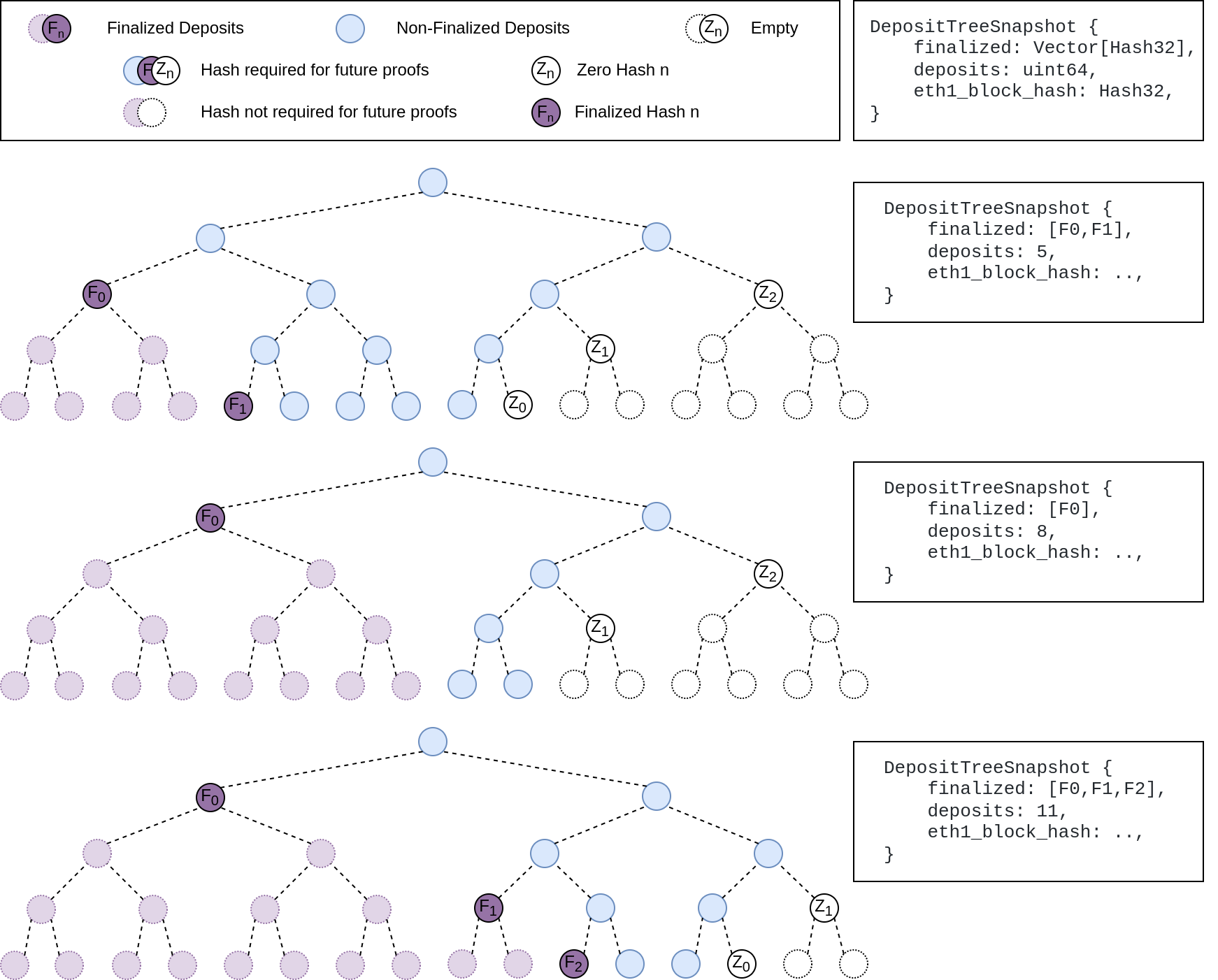
The deposit cache now has the ability to finalize deposits. This will cause it to drop unneeded deposit logs and hashes in the deposit Merkle tree that are no longer required to construct deposit proofs. The cache is finalized whenever the latest finalized checkpoint has a new `Eth1Data` with all deposits imported.
This has three benefits:
1. Improves the speed of constructing Merkle proofs for deposits as we can just replay deposits since the last finalized checkpoint instead of all historical deposits when re-constructing the Merkle tree.
2. Significantly faster weak subjectivity sync as the deposit cache can be transferred to the newly syncing node in compressed form. The Merkle tree that stores `N` finalized deposits requires a maximum of `log2(N)` hashes. The newly syncing node then only needs to download deposits since the last finalized checkpoint to have a full tree.
3. Future proofing in preparation for [EIP-4444](https://eips.ethereum.org/EIPS/eip-4444) as execution nodes will no longer be required to store logs permanently so we won't always have all historical logs available to us.
## More Details
Image to illustrate how the deposit contract merkle tree evolves and finalizes along with the resulting `DepositTreeSnapshot`
## Other Considerations
I've changed the structure of the `SszDepositCache` so once you load & save your database from this version of lighthouse, you will no longer be able to load it from older versions.
Co-authored-by: ethDreamer <37123614+ethDreamer@users.noreply.github.com>
## Issue Addressed
fixes lints from the last rust release

## Proposed Changes
Fix the lints, most of the lints by `clippy::question-mark` are false positives in the form of https://github.com/rust-lang/rust-clippy/issues/9518 so it's allowed for now

## Additional Info
## Issue Addressed

NA

## Proposed Changes

This PR removes duplicated block root computation.

Computing the `SignedBeaconBlock::canonical_root` has become more expensive since the merge as we need to compute the merke root of each transaction inside an `ExecutionPayload`.

Computing the root for [a mainnet block](https://beaconcha.in/slot/4704236) is taking ~10ms on my i7-8700K CPU @ 3.70GHz (no sha extensions). Given that our median seen-to-imported time for blocks is presently 300-400ms, removing a few duplicated block roots (~30ms) could represent an easy 10% improvement. When we consider that the seen-to-imported times include operations *after* the block has been placed in the early attester cache, we could expect the 30ms to be more significant WRT our seen-to-attestable times.

## Additional Info

NA

