## Issue Addressed
Closes#3814, replaces #3818.
## Proposed Changes
* Add a WARN log for the case where we are attempting to sync chain segments but can't process them because they're building on an invalid parent. The most common case where we see this is when the execution node database is corrupt, causing sync to stall mysteriously (because we're currently logging the failure only at debug level).
* Additionally I've bumped up the logging for invalid execution payloads to `WARN`. This may result in some duplicate logs as we log errors from the `beacon_chain` and then again from the beacon processor. Invalid payloads and corrupt DBs _should_ be rare enough that this doesn't produce overwhelming log volume.
## Issue Addressed

NA

## Description

We were missing an edge case when checking to see if a block is a descendant of the finalized checkpoint. This edge case is described for one of the tests in this PR:

a119edc739/consensus/proto_array/src/proto_array_fork_choice.rs (L1018-L1047)

This bug presented itself in the following mainnet log:

```
Jan 26 15:12:42.841 ERRO Unable to validate attestation error: MissingBeaconState(0x7c30cb80ec3d4ec624133abfa70e4c6cfecfca456bfbbbff3393e14e5b20bf25), peer_id: 16Uiu2HAm8RPRciXJYtYc5c3qtCRdrZwkHn2BXN3XP1nSi1gxHYit, type: "unaggregated", slot: Slot(5660161), beacon_block_root: 0x4a45e59da7cb9487f4836c83bdd1b741b4f31c67010c7ae343fa6771b3330489
```

Here the BN is rejecting an attestation because of a "missing beacon state". Whilst it was correct to reject the attestation, it should have rejected it because it attests to a block that conflicts with finality rather than claiming that the database is inconsistent.

The block that this attestation points to (`0x4a45`) is block `C` in the above diagram. It is a non-canonical block in the first slot of an epoch that conflicts with the finalized checkpoint. Due to our lazy pruning of proto array, `0x4a45` was still present in proto-array. Our missed edge-case in [`ForkChoice::is_descendant_of_finalized`](38514c07f2/consensus/fork_choice/src/fork_choice.rs (L1375-L1379)) would have indicated to us that the block is a descendant of the finalized block. Therefore, we would have accepted the attestation thinking that it attests to a descendant of the finalized *checkpoint*.

Since we didn't have the shuffling for this erroneously processed block, we attempted to read its state from the database. This failed because we prune states from the database by keeping track of the tips of the chain and iterating back until we find a finalized block. This would have deleted `C` from the database, hence the `MissingBeaconState` error.
## Proposed Changes

Clippy 1.67.0 put us on blast for the size of some of our errors, most of them written by me ( 👀 ). This PR shrinks the size of `BeaconChainError` by dropping some extraneous info and boxing an inner error which should only occur infrequently anyway.

For the `AttestationSlashInfo` and `BlockSlashInfo` I opted to ignore the lint as they are always used in a `Result<A, Info>` where `A` is a similar size. This means they don't bloat the size of the `Result`, so it's a bit annoying for Clippy to report this as an issue.

I also chose to ignore `clippy::uninlined-format-args` because I think the benefit-to-churn ratio is too low. E.g. sometimes we have long identifiers in `format!` args and IMO the non-inlined form is easier to read:

```rust
// I prefer this...
format!(
    "{} did {} to {}",
    REALLY_LONG_CONSTANT_NAME,
    ANOTHER_REALLY_LONG_CONSTANT_NAME,
    regular_long_identifier_name
);

// To this
format!("{REALLY_LONG_CONSTANT_NAME} did {ANOTHER_REALLY_LONG_CONSTANT_NAME} to {regular_long_identifier_name}");
```

I tried generating an automatic diff with `cargo clippy --fix` but it came out at:

```
250 files changed, 1209 insertions(+), 1469 deletions(-)
```

Which seems like a bad idea when we'd have to back-merge it to `capella` and `eip4844` 😱
## Issue Addressed

Closes https://github.com/sigp/lighthouse/issues/2327

## Proposed Changes

This is an extension of some ideas I implemented while working on `tree-states`:

- Cache the indexed attestations from blocks in the `ConsensusContext`. Previously we were re-computing them 3-4 times over.
- Clean up `import_block` by splitting each part into `import_block_XXX`.
- Move some stuff off hot paths, specifically:
  - Relocate non-essential tasks that were running between receiving the payload verification status and priming the early attester cache. These tasks are moved after the cache priming:
    - Attestation observation
    - Validator monitor updates
    - Slasher updates
    - Updating the shuffling cache
  - Fork choice attestation observation now happens at the end of block verification in parallel with payload verification (this seems to save 5-10ms).
  - Payload verification now happens _before_ advancing the pre-state and writing it to disk! States were previously being written eagerly and adding ~20-30ms in front of verifying the execution payload. State catchup also sometimes takes ~500ms if we get a cache miss and need to rebuild the tree hash cache.

The remaining task that's taking substantial time (~20ms) is importing the block to fork choice. I _think_ this is because of pull-tips, and we should be able to optimise it out with a clever total active balance cache in the state (which would be computed in parallel with payload verification). I've decided to leave that for future work though. For now it can be observed via the new `beacon_block_processing_post_exec_pre_attestable_seconds` metric.


Co-authored-by: Michael Sproul <micsproul@gmail.com>
## Issue Addressed

#3704

## Proposed Changes
Adds is_syncing_finalized: bool parameter for block verification functions. Sets the payload_verification_status to Optimistic if is_syncing_finalized is true. Uses SyncState in NetworkGlobals in BeaconProcessor to retrieve the syncing status.

## Additional Info
I could implement FinalizedSignatureVerifiedBlock if you think it would be nicer.
## Summary
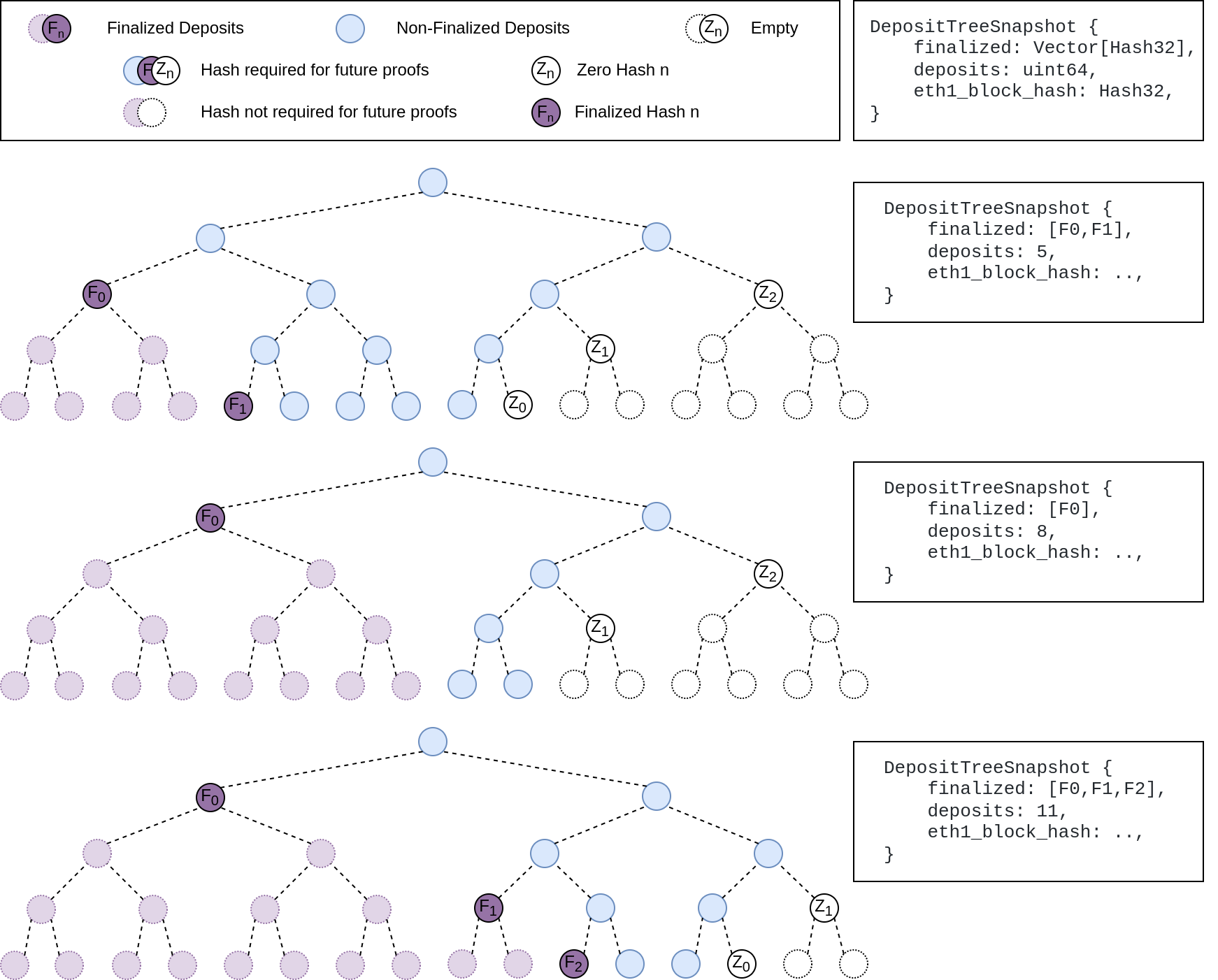
The deposit cache now has the ability to finalize deposits. This will cause it to drop unneeded deposit logs and hashes in the deposit Merkle tree that are no longer required to construct deposit proofs. The cache is finalized whenever the latest finalized checkpoint has a new `Eth1Data` with all deposits imported.
This has three benefits:
1. Improves the speed of constructing Merkle proofs for deposits as we can just replay deposits since the last finalized checkpoint instead of all historical deposits when re-constructing the Merkle tree.
2. Significantly faster weak subjectivity sync as the deposit cache can be transferred to the newly syncing node in compressed form. The Merkle tree that stores `N` finalized deposits requires a maximum of `log2(N)` hashes. The newly syncing node then only needs to download deposits since the last finalized checkpoint to have a full tree.
3. Future proofing in preparation for [EIP-4444](https://eips.ethereum.org/EIPS/eip-4444) as execution nodes will no longer be required to store logs permanently so we won't always have all historical logs available to us.
## More Details
Image to illustrate how the deposit contract merkle tree evolves and finalizes along with the resulting `DepositTreeSnapshot`
## Other Considerations
I've changed the structure of the `SszDepositCache` so once you load & save your database from this version of lighthouse, you will no longer be able to load it from older versions.
Co-authored-by: ethDreamer <37123614+ethDreamer@users.noreply.github.com>
* add capella gossip boiler plate

* get everything compiling

Co-authored-by: realbigsean <sean@sigmaprime.io
Co-authored-by: Mark Mackey <mark@sigmaprime.io>

* small cleanup

* small cleanup

* cargo fix + some test cleanup

* improve block production

* add fixme for potential panic

Co-authored-by: Mark Mackey <mark@sigmaprime.io>
## Issue Addressed

Closes https://github.com/sigp/lighthouse/issues/2371

## Proposed Changes

Backport some changes from `tree-states` that remove duplicated calculations of the `proposer_index`.

With this change the proposer index should be calculated only once for each block, and then plumbed through to every place it is required.

## Additional Info

In future I hope to add more data to the consensus context that is cached on a per-epoch basis, like the effective balances of validators and the base rewards.

There are some other changes to remove indexing in tests that were also useful for `tree-states` (the `tree-states` types don't implement `Index`).
## Issue Addressed

NA

## Proposed Changes

This PR removes duplicated block root computation.

Computing the `SignedBeaconBlock::canonical_root` has become more expensive since the merge as we need to compute the merke root of each transaction inside an `ExecutionPayload`.

Computing the root for [a mainnet block](https://beaconcha.in/slot/4704236) is taking ~10ms on my i7-8700K CPU @ 3.70GHz (no sha extensions). Given that our median seen-to-imported time for blocks is presently 300-400ms, removing a few duplicated block roots (~30ms) could represent an easy 10% improvement. When we consider that the seen-to-imported times include operations *after* the block has been placed in the early attester cache, we could expect the 30ms to be more significant WRT our seen-to-attestable times.

## Additional Info

NA
## Proposed Changes

This PR has two aims: to speed up attestation packing in the op pool, and to fix bugs in the verification of attester slashings, proposer slashings and voluntary exits. The changes are bundled into a single database schema upgrade (v12).

Attestation packing is sped up by removing several inefficiencies:

- No more recalculation of `attesting_indices` during packing.
- No (unnecessary) examination of the `ParticipationFlags`: a bitfield suffices. See `RewardCache`.
- No re-checking of attestation validity during packing: the `AttestationMap` provides attestations which are "correct by construction" (I have checked this using Hydra).
- No SSZ re-serialization for the clunky `AttestationId` type (it can be removed in a future release).

So far the speed-up seems to be roughly 2-10x, from 500ms down to 50-100ms.

Verification of attester slashings, proposer slashings and voluntary exits is fixed by:

- Tracking the `ForkVersion`s that were used to verify each message inside the `SigVerifiedOp`. This allows us to quickly re-verify that they match the head state's opinion of what the `ForkVersion` should be at the epoch(s) relevant to the message.
- Storing the `SigVerifiedOp` on disk rather than the raw operation. This allows us to continue track the fork versions after a reboot.

This is mostly contained in this commit 52bb1840ae.

## Additional Info

The schema upgrade uses the justified state to re-verify attestations and compute `attesting_indices` for them. It will drop any attestations that fail to verify, by the logic that attestations are most valuable in the few slots after they're observed, and are probably stale and useless by the time a node restarts. Exits and proposer slashings and similarly re-verified to obtain `SigVerifiedOp`s.

This PR contains a runtime killswitch `--paranoid-block-proposal` which opts out of all the optimisations in favour of closely verifying every included message. Although I'm quite sure that the optimisations are correct this flag could be useful in the event of an unforeseen emergency.

Finally, you might notice that the `RewardCache` appears quite useless in its current form because it is only updated on the hot-path immediately before proposal. My hope is that in future we can shift calls to `RewardCache::update` into the background, e.g. while performing the state advance. It is also forward-looking to `tree-states` compatibility, where iterating and indexing `state.{previous,current}_epoch_participation` is expensive and needs to be minimised.

