## Issue Addressed

#4118

## Proposed Changes

This PR introduces a "progressive balances" cache on the `BeaconState`, which keeps track of the accumulated target attestation balance for the current & previous epochs. The cached values are utilised by fork choice to calculate unrealized justification and finalization (instead of converting epoch participation arrays to balances for each block we receive).

This optimization will be rolled out gradually to allow for more testing. A new `--progressive-balances disabled|checked|strict|fast` flag is introduced to support this:
- `checked`: enabled with checks against participation cache, and falls back to the existing epoch processing calculation if there is a total target attester balance mismatch. There is no performance gain from this as the participation cache still needs to be computed. **This is the default mode for now.**
- `strict`: enabled with checks against participation cache, returns error if there is a mismatch. **Used for testing only**.
- `fast`: enabled with no comparative checks and without computing the participation cache. This mode gives us the performance gains from the optimization. This is still experimental and not currently recommended for production usage, but will become the default mode in a future release.
- `disabled`: disable the usage of progressive cache, and use the existing method for FFG progression calculation. This mode may be useful if we find a bug and want to stop the frequent error logs.

### Tasks

- [x] Initial cache implementation in `BeaconState`
- [x] Perform checks in fork choice to compare the progressive balances cache against results from `ParticipationCache`
- [x] Add CLI flag, and disable the optimization by default
- [x] Testing on Goerli & Benchmarking
- [x]  Move caching logic from state processing to the `ProgressiveBalancesCache` (see [this comment](https://github.com/sigp/lighthouse/pull/4362#discussion_r1230877001))
- [x] Add attesting balance metrics


Co-authored-by: Jimmy Chen <jimmy@sigmaprime.io>
## Issue Addressed

 - #4293
 - #4264

## Proposed Changes

*Changes largely follow those suggested in the main issue*.

 - Add new routes to HTTP API
   - `post_beacon_blocks_v2`
   - `post_blinded_beacon_blocks_v2`
 - Add new routes to `BeaconNodeHttpClient`
   - `post_beacon_blocks_v2`
   - `post_blinded_beacon_blocks_v2`
 - Define new Eth2 common types
   - `BroadcastValidation`, enum representing the level of validation to apply to blocks prior to broadcast
   - `BroadcastValidationQuery`, the corresponding HTTP query string type for the above type
 - ~~Define `_checked` variants of both `publish_block` and `publish_blinded_block` that enforce a validation level at a type level~~
 - Add interactive tests to the `bn_http_api_tests` test target covering each validation level (to their own test module, `broadcast_validation_tests`)
   - `beacon/blocks`
       - `broadcast_validation=gossip`
         - Invalid (400)
         - Full Pass (200)
         - Partial Pass (202)
        - `broadcast_validation=consensus`
          - Invalid (400)
          - Only gossip (400)
          - Only consensus pass (i.e., equivocates) (200)
          - Full pass (200)
        - `broadcast_validation=consensus_and_equivocation`
          - Invalid (400)
          - Invalid due to early equivocation (400)
          - Only gossip (400)
          - Only consensus (400)
          - Pass (200)
   - `beacon/blinded_blocks`
       - `broadcast_validation=gossip`
         - Invalid (400)
         - Full Pass (200)
         - Partial Pass (202)
        - `broadcast_validation=consensus`
          - Invalid (400)
          - Only gossip (400)
          - ~~Only consensus pass (i.e., equivocates) (200)~~
          - Full pass (200)
        - `broadcast_validation=consensus_and_equivocation`
          - Invalid (400)
          - Invalid due to early equivocation (400)
          - Only gossip (400)
          - Only consensus (400)
          - Pass (200)
 - Add a new trait, `IntoGossipVerifiedBlock`, which allows type-level guarantees to be made as to gossip validity
 - Modify the structure of the `ObservedBlockProducers` cache from a `(slot, validator_index)` mapping to a `((slot, validator_index), block_root)` mapping
 - Modify `ObservedBlockProducers::proposer_has_been_observed` to return a `SeenBlock` rather than a boolean on success
 - Punish gossip peer (low) for submitting equivocating blocks
 - Rename `BlockError::SlashablePublish` to `BlockError::SlashableProposal`

## Additional Info

This PR contains changes that directly modify how blocks are verified within the client. For more context, consult [comments in-thread](https://github.com/sigp/lighthouse/pull/4316#discussion_r1234724202).


Co-authored-by: Michael Sproul <michael@sigmaprime.io>
## Issue Addressed
Closes#4332
## Proposed Changes
Remove the `CountUnrealized` type, defaulting unrealized justification to _on_. This fixes the #4332 issue by ensuring that importing the same block to fork choice always results in the same outcome.
Finalized sync speed may be slightly impacted by this change, but that is deemed an acceptable trade-off until the optimisation from #4118 is implemented.
TODO:
- [x] Also check that the block isn't a duplicate before importing
* some blob reprocessing work

* remove ForceBlockLookup

* reorder enum match arms in sync manager

* a lot more reprocessing work

* impl logic for triggerng blob lookups along with block lookups

* deal with rpc blobs in groups per block in the da checker. don't cache missing blob ids in the da checker.

* make single block lookup generic

* more work

* add delayed processing logic and combine some requests

* start fixing some compile errors

* fix compilation in main block lookup mod

* much work

* get things compiling

* parent blob lookups

* fix compile

* revert red/stevie changes

* fix up sync manager delay message logic

* add peer usefulness enum

* should remove lookup refactor

* consolidate retry error handling

* improve peer scoring during certain failures in parent lookups

* improve retry code

* drop parent lookup if either req has a peer disconnect during download

* refactor single block processed method

* processing peer refactor

* smol bugfix

* fix some todos

* fix lints

* fix lints

* fix compile in lookup tests

* fix lints

* fix lints

* fix existing block lookup tests

* renamings

* fix after merge

* cargo fmt

* compilation fix in beacon chain tests

* fix

* refactor lookup tests to work with multiple forks and response types

* make tests into macros

* wrap availability check error

* fix compile after merge

* add random blobs

* start fixing up lookup verify error handling

* some bug fixes and the start of deneb only tests

* make tests work for all forks

* track information about peer source

* error refactoring

* improve peer scoring

* fix test compilation

* make sure blobs are sent for processing after stream termination, delete copied tests

* add some tests and fix a bug

* smol bugfixes and moar tests

* add tests and fix some things

* compile after merge

* lots of refactoring

* retry on invalid block/blob

* merge unknown parent messages before current slot lookup

* get tests compiling

* penalize blob peer on invalid blobs

* Check disk on in-memory cache miss

* Update beacon_node/beacon_chain/src/data_availability_checker/overflow_lru_cache.rs

* Update beacon_node/network/src/sync/network_context.rs

Co-authored-by: Divma <26765164+divagant-martian@users.noreply.github.com>

* fix bug in matching blocks and blobs in range sync

* pr feedback

* fix conflicts

* upgrade logs from warn to crit when we receive incorrect response in range

* synced_and_connected_within_tolerance -> should_search_for_block

* remove todo

* Fix Broken Overflow Tests

* fix merge conflicts

* checkpoint sync without alignment

* add import

* query for checkpoint state by slot rather than state root (teku doesn't serve by state root)

* get state first and query by most recent block root

* simplify delay logic

* rename unknown parent sync message variants

* rename parameter, block_slot -> slot

* add some docs to the lookup module

* use interval instead of sleep

* drop request if blocks and blobs requests both return `None` for `Id`

* clean up `find_single_lookup` logic

* add lookup source enum

* clean up `find_single_lookup` logic

* add docs to find_single_lookup_request

* move LookupSource our of param where unnecessary

* remove unnecessary todo

* query for block by `state.latest_block_header.slot`

* fix lint

* fix test

* fix test

* fix observed  blob sidecars test

* PR updates

* use optional params instead of a closure

* create lookup and trigger request in separate method calls

* remove `LookupSource`

* make sure duplicate lookups are not dropped

---------

Co-authored-by: Pawan Dhananjay <pawandhananjay@gmail.com>
Co-authored-by: Mark Mackey <mark@sigmaprime.io>
Co-authored-by: Divma <26765164+divagant-martian@users.noreply.github.com>
## Issue Addressed

#4281

## Proposed Changes

- Change `ShufflingCache` implementation from using `LruCache` to a custom cache that removes entry with lowest epoch instead of oldest insertion time.
- Protect the "enshrined" head shufflings when inserting new committee cache entries. The shuffling ids matching the head's previous, current, and future epochs will never be ejected from the cache during `Self::insert_cache_item`.

## Additional Info

There is a bonus point on shuffling preferences in the issue description that hasn't been implemented yet, as I haven't figured out a good way to do this:

> However I'm not convinced since there are some complexities around tie-breaking when two entries have the same epoch. Perhaps preferring entries in the canonical chain is best?

We should be able to check if a block is on the canonical chain by:

```rust
canonical_head
        .fork_choice_read_lock()
        .contains_block(root)
```

However we need to interleave the shuffling and fork choice locks, which may cause deadlocks if we're not careful (mentioned by @paulhauner). Alternatively, we could use the `state.block_roots` field of the `chain.canonical_head.snapshot.beacon_state`, which avoids deadlock but requires more work.

I'd like to get some feedback on review & testing before I dig deeper into the preferences stuff, as having the canonical head preference may already be quite useful in preventing the issue raised.


Co-authored-by: Jimmy Chen <jimmy@sigmaprime.io>
## Limit Backfill Sync

This PR transitions Lighthouse from syncing all the way back to genesis to only syncing back to the weak subjectivity point (~ 5 months) when syncing via a checkpoint sync.

There are a number of important points to note with this PR:

- Firstly and most importantly, this PR fundamentally shifts the default security guarantees of checkpoint syncing in Lighthouse. Prior to this PR, Lighthouse could verify the checkpoint of any given chain by ensuring the chain eventually terminates at the corresponding genesis. This guarantee can still be employed via the new CLI flag --genesis-backfill which will prompt lighthouse to the old behaviour of downloading all blocks back to genesis. The new behaviour only checks the proposer signatures for the last 5 months of blocks but cannot guarantee the chain matches the genesis chain.
- I have not modified any of the peer scoring or RPC responses. Clients syncing from gensis, will downscore new Lighthouse peers that do not possess blocks prior to the WSP. This is by design, as Lighthouse nodes of this form, need a mechanism to sort through peers in order to find useful peers in order to complete their genesis sync. We therefore do not discriminate between empty/error responses for blocks prior or post the local WSP. If we request a block that a peer does not posses, then fundamentally that peer is less useful to us than other peers.
- This will make a radical shift in that the majority of nodes will no longer store the full history of the chain. In the future we could add a pruning mechanism to remove old blocks from the db also.


Co-authored-by: Paul Hauner <paul@paulhauner.com>
## Proposed Changes

This change attempts to prevent failed re-orgs by:

1. Lowering the re-org cutoff from 2s to 1s. This is informed by a failed re-org attempted by @yorickdowne's node. The failed block was requested in the 1.5-2s window due to a Vouch failure, and failed to propagate to the majority of the network before the attestation deadline at 4s.
2. Allow users to adjust their re-org cutoff depending on observed network conditions and their risk profile. The static 2 second cutoff was too rigid.
3. Add a `--proposer-reorg-disallowed-offsets` flag which can be used to prohibit reorgs at certain slots. This is intended to help workaround an issue whereby reorging blocks at slot 1 are currently taking ~1.6s to propagate on gossip rather than ~500ms. This is suspected to be due to a cache miss in current versions of Prysm, which should be fixed in their next release.

## Additional Info

I'm of two minds about removing the `shuffling_stable` check which checks for blocks at slot 0 in the epoch. If we removed it users would be able to configure Lighthouse to try reorging at slot 0, which likely wouldn't work very well due to interactions with the proposer index cache. I think we could leave it for now and revisit it later.
* introduce availability pending block

* add intoavailableblock trait

* small fixes

* add 'gossip blob cache' and start to clean up processing and transition types

* shard memory blob cache

* Initial commit

* Fix after rebase

* Add gossip verification conditions

* cache cleanup

* general chaos

* extended chaos

* cargo fmt

* more progress

* more progress

* tons of changes, just tryna compile

* everything, everywhere, all at once

* Reprocess an ExecutedBlock on unavailable blobs

* Add sus gossip verification for blobs

* Merge stuff

* Remove reprocessing cache stuff

* lint

* Add a wrapper to allow construction of only valid `AvailableBlock`s

* rename blob arc list to blob list

* merge cleanuo

* Revert "merge cleanuo"

This reverts commit 5e98326878.

* Revert "Revert "merge cleanuo""

This reverts commit 3a4009443a.

* fix rpc methods

* move beacon block and blob to eth2/types

* rename gossip blob cache to data availability checker

* lots of changes

* fix some compilation issues

* fix compilation issues

* fix compilation issues

* fix compilation issues

* fix compilation issues

* fix compilation issues

* cargo fmt

* use a common data structure for block import types

* fix availability check on proposal import

* refactor the blob cache and split the block wrapper into two types

* add type conversion for signed block and block wrapper

* fix beacon chain tests and do some renaming, add some comments

* Partial processing (#4)

* move beacon block and blob to eth2/types

* rename gossip blob cache to data availability checker

* lots of changes

* fix some compilation issues

* fix compilation issues

* fix compilation issues

* fix compilation issues

* fix compilation issues

* fix compilation issues

* cargo fmt

* use a common data structure for block import types

* fix availability check on proposal import

* refactor the blob cache and split the block wrapper into two types

* add type conversion for signed block and block wrapper

* fix beacon chain tests and do some renaming, add some comments

* cargo update (#6)

---------

Co-authored-by: realbigsean <sean@sigmaprime.io>
Co-authored-by: realbigsean <seananderson33@gmail.com>
## Issue Addressed

NA

## Proposed Changes

- Implements https://github.com/ethereum/consensus-specs/pull/3290/
- Bumps `ef-tests` to [v1.3.0-rc.4](https://github.com/ethereum/consensus-spec-tests/releases/tag/v1.3.0-rc.4).

The `CountRealizedFull` concept has been removed and the `--count-unrealized-full` and `--count-unrealized` BN flags now do nothing but log a `WARN` when used.

## Database Migration Debt

This PR removes the `best_justified_checkpoint` from fork choice. This field is persisted on-disk and the correct way to go about this would be to make a DB migration to remove the field. However, in this PR I've simply stubbed out the value with a junk value. I've taken this approach because if we're going to do a DB migration I'd love to remove the `Option`s around the justified and finalized checkpoints on `ProtoNode` whilst we're at it. Those options were added in #2822 which was included in Lighthouse v2.1.0. The options were only put there to handle the migration and they've been set to `Some` ever since v2.1.0. There's no reason to keep them as options anymore.

I started adding the DB migration to this branch but I started to feel like I was bloating this rather critical PR with nice-to-haves. I've kept the partially-complete migration [over in my repo](https://github.com/paulhauner/lighthouse/tree/fc-pr-18-migration) so we can pick it up after this PR is merged.
This PR enables the user to adjust the shuffling cache size.

This is useful for some HTTP API requests which require re-computing old shufflings. This PR currently optimizes the
beacon/states/{state_id}/committees HTTP API by first checking the cache before re-building shuffling.

If the shuffling is set to a non-default value, then the HTTP API request will also fill the cache when as it constructs new shufflings.

If the CLI flag is not present or the value is set to the default of 16 the default behaviour is observed.


Co-authored-by: Michael Sproul <michael@sigmaprime.io>
## Issue Addressed

NA

## Proposed Changes

Myself and others (#3678) have observed  that when running with lots of validators (e.g., 1000s) the cardinality is too much for Prometheus. I've seen Prometheus instances just grind to a halt when we turn the validator monitor on for our testnet validators (we have 10,000s of Goerli validators). Additionally, the debug log volume can get very high with one log per validator, per attestation.

To address this, the `bn --validator-monitor-individual-tracking-threshold <INTEGER>` flag has been added to *disable* per-validator (i.e., non-aggregated) metrics/logging once the validator monitor exceeds the threshold of validators. The default value is `64`, which is a finger-to-the-wind value. I don't actually know the value at which Prometheus starts to become overwhelmed, but I've seen it work with ~64 validators and I've seen it *not* work with 1000s of validators. A default of `64` seems like it will result in a breaking change to users who are running millions of dollars worth of validators whilst resulting in a no-op for low-validator-count users. I'm open to changing this number, though.

Additionally, this PR starts collecting aggregated Prometheus metrics (e.g., total count of head hits across all validators), so that high-validator-count validators still have some interesting metrics. We already had logging for aggregated values, so nothing has been added there.

I've opted to make this a breaking change since it can be rather damaging to your Prometheus instance to accidentally enable the validator monitor with large numbers of validators. I've crashed a Prometheus instance myself and had a report from another user who's done the same thing.

## Additional Info

NA

## Breaking Changes Note

A new label has been added to the validator monitor Prometheus metrics: `total`. This label tracks the aggregated metrics of all validators in the validator monitor (as opposed to each validator being tracking individually using its pubkey as the label).

Additionally, a new flag has been added to the Beacon Node: `--validator-monitor-individual-tracking-threshold`. The default value is `64`, which means that when the validator monitor is tracking more than 64 validators then it will stop tracking per-validator metrics and only track the `all_validators` metric. It will also stop logging per-validator logs and only emit aggregated logs (the exception being that exit and slashing logs are always emitted).

These changes were introduced in #3728 to address issues with untenable Prometheus cardinality and log volume when using the validator monitor with high validator counts (e.g., 1000s of validators). Users with less than 65 validators will see no change in behavior (apart from the added `all_validators` metric). Users with more than 65 validators who wish to maintain the previous behavior can set something like `--validator-monitor-individual-tracking-threshold 999999`.
## Proposed Changes

With proposer boosting implemented (#2822) we have an opportunity to re-org out late blocks.

This PR adds three flags to the BN to control this behaviour:

* `--disable-proposer-reorgs`: turn aggressive re-orging off (it's on by default).
* `--proposer-reorg-threshold N`: attempt to orphan blocks with less than N% of the committee vote. If this parameter isn't set then N defaults to 20% when the feature is enabled.
* `--proposer-reorg-epochs-since-finalization N`: only attempt to re-org late blocks when the number of epochs since finalization is less than or equal to N. The default is 2 epochs, meaning re-orgs will only be attempted when the chain is finalizing optimally.

For safety Lighthouse will only attempt a re-org under very specific conditions:

1. The block being proposed is 1 slot after the canonical head, and the canonical head is 1 slot after its parent. i.e. at slot `n + 1` rather than building on the block from slot `n` we build on the block from slot `n - 1`.
2. The current canonical head received less than N% of the committee vote. N should be set depending on the proposer boost fraction itself, the fraction of the network that is believed to be applying it, and the size of the largest entity that could be hoarding votes.
3. The current canonical head arrived after the attestation deadline from our perspective. This condition was only added to support suppression of forkchoiceUpdated messages, but makes intuitive sense.
4. The block is being proposed in the first 2 seconds of the slot. This gives it time to propagate and receive the proposer boost.


## Additional Info

For the initial idea and background, see: https://github.com/ethereum/consensus-specs/pull/2353#issuecomment-950238004

There is also a specification for this feature here: https://github.com/ethereum/consensus-specs/pull/3034

Co-authored-by: Michael Sproul <micsproul@gmail.com>
Co-authored-by: pawan <pawandhananjay@gmail.com>
## Issue Addressed
Implementing the light_client_gossip topics but I'm not there yet.

Which issue # does this PR address?
Partially #3651

## Proposed Changes
Add light client gossip topics.
Please list or describe the changes introduced by this PR.
I'm going to Implement light_client_finality_update and light_client_optimistic_update gossip topics. Currently I've attempted the former and I'm seeking feedback.

## Additional Info
I've only implemented the light_client_finality_update topic because I wanted to make sure I was on the correct path. Also checking that the gossiped LightClientFinalityUpdate is the same as the locally constructed one is not implemented because caching the updates will make this much easier. Could someone give me some feedback on this please?

Please provide any additional information. For example, future considerations
or information useful for reviewers.

Co-authored-by: GeemoCandama <104614073+GeemoCandama@users.noreply.github.com>
## Summary
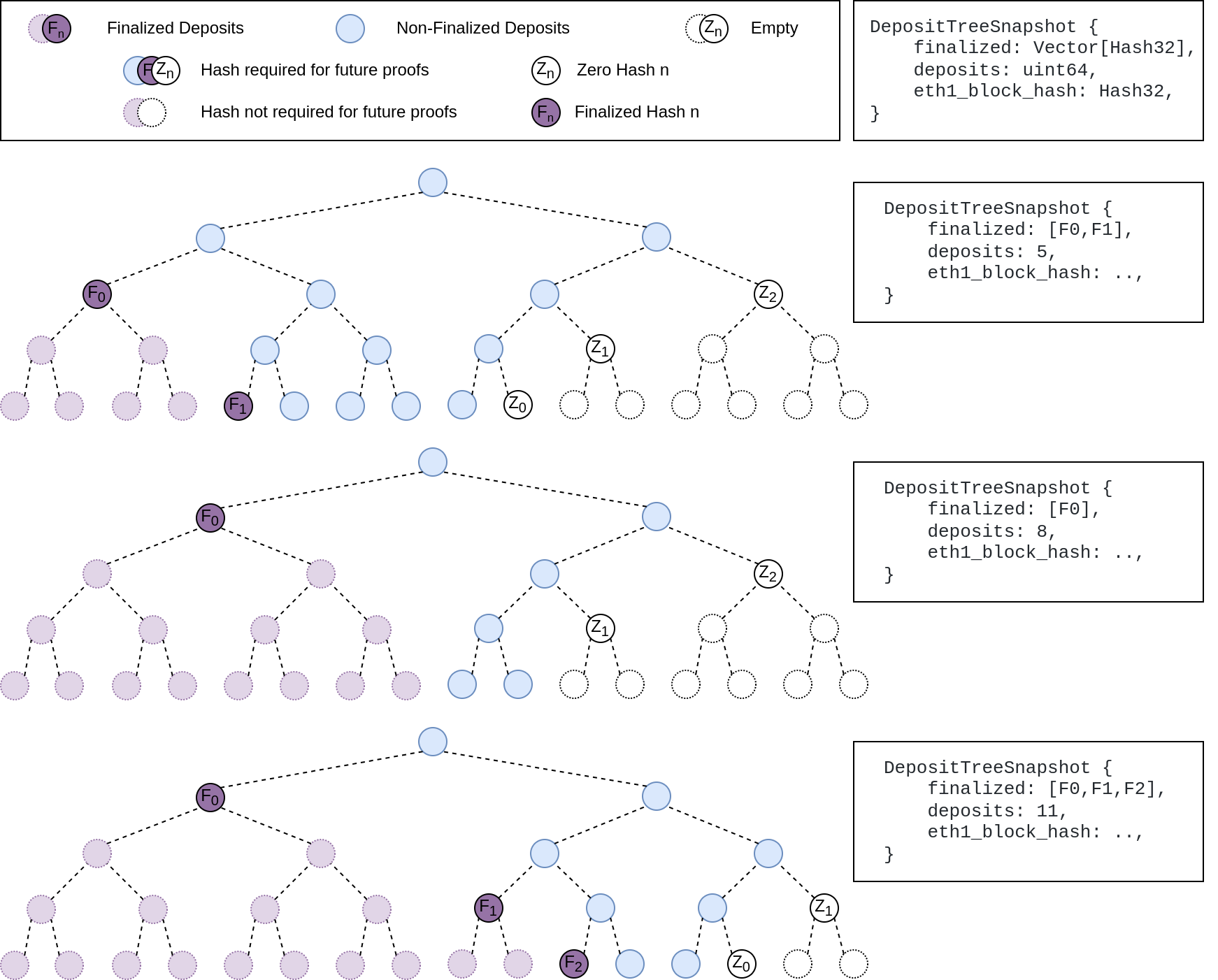
The deposit cache now has the ability to finalize deposits. This will cause it to drop unneeded deposit logs and hashes in the deposit Merkle tree that are no longer required to construct deposit proofs. The cache is finalized whenever the latest finalized checkpoint has a new `Eth1Data` with all deposits imported.
This has three benefits:
1. Improves the speed of constructing Merkle proofs for deposits as we can just replay deposits since the last finalized checkpoint instead of all historical deposits when re-constructing the Merkle tree.
2. Significantly faster weak subjectivity sync as the deposit cache can be transferred to the newly syncing node in compressed form. The Merkle tree that stores `N` finalized deposits requires a maximum of `log2(N)` hashes. The newly syncing node then only needs to download deposits since the last finalized checkpoint to have a full tree.
3. Future proofing in preparation for [EIP-4444](https://eips.ethereum.org/EIPS/eip-4444) as execution nodes will no longer be required to store logs permanently so we won't always have all historical logs available to us.
## More Details
Image to illustrate how the deposit contract merkle tree evolves and finalizes along with the resulting `DepositTreeSnapshot`
## Other Considerations
I've changed the structure of the `SszDepositCache` so once you load & save your database from this version of lighthouse, you will no longer be able to load it from older versions.
Co-authored-by: ethDreamer <37123614+ethDreamer@users.noreply.github.com>
## Issue Addressed

N/A

## Proposed Changes

With https://github.com/sigp/lighthouse/pull/3214 we made it such that you can either have 1 auth endpoint or multiple non auth endpoints. Now that we are post merge on all networks (testnets and mainnet), we cannot progress a chain without a dedicated auth execution layer connection so there is no point in having a non-auth eth1-endpoint for syncing deposit cache.

This code removes all fallback related code in the eth1 service. We still keep the single non-auth endpoint since it's useful for testing.

## Additional Info

This removes all eth1 fallback related metrics that were relevant for the monitoring service, so we might need to change the api upstream.
## Proposed Changes

Improve the payload pruning feature in several ways:

- Payload pruning is now entirely optional. It is enabled by default but can be disabled with `--prune-payloads false`. The previous `--prune-payloads-on-startup` flag from #3565 is removed.
- Initial payload pruning on startup now runs in a background thread. This thread will always load the split state, which is a small fraction of its total work (up to ~300ms) and then backtrack from that state. This pruning process ran in 2m5s on one Prater node with good I/O and 16m on a node with slower I/O.
- To work with the optional payload pruning the database function `try_load_full_block` will now attempt to load execution payloads for finalized slots _if_ pruning is currently disabled. This gives users an opt-out for the extensive traffic between the CL and EL for reconstructing payloads.

## Additional Info

If the `prune-payloads` flag is toggled on and off then the on-startup check may not see any payloads to delete and fail to clean them up. In this case the `lighthouse db prune_payloads` command should be used to force a manual sweep of the database.
## Issue Addressed

Closes https://github.com/sigp/lighthouse/issues/3556

## Proposed Changes

Delete finalized execution payloads from the database in two places:

1. When running the finalization migration in `migrate_database`. We delete the finalized payloads between the last split point and the new updated split point. _If_ payloads are already pruned prior to this then this is sufficient to prune _all_ payloads as non-canonical payloads are already deleted by the head pruner, and all canonical payloads prior to the previous split will already have been pruned.
2. To address the fact that users will update to this code _after_ the merge on mainnet (and testnets), we need a one-off scan to delete the finalized payloads from the canonical chain. This is implemented in `try_prune_execution_payloads` which runs on startup and scans the chain back to the Bellatrix fork or the anchor slot (if checkpoint synced after Bellatrix). In the case where payloads are already pruned this check only imposes a single state load for the split state, which shouldn't be _too slow_. Even so, a flag `--prepare-payloads-on-startup=false` is provided to turn this off after it has run the first time, which provides faster start-up times.

There is also a new `lighthouse db prune_payloads` subcommand for users who prefer to run the pruning manually.

## Additional Info

The tests have been updated to not rely on finalized payloads in the database, instead using the `MockExecutionLayer` to reconstruct them. Additionally a check was added to `check_chain_dump` which asserts the non-existence or existence of payloads on disk depending on their slot.
## Issue Addressed

Add a flag that can increase count unrealized strictness, defaults to false

## Proposed Changes

Please list or describe the changes introduced by this PR.

## Additional Info

Please provide any additional information. For example, future considerations
or information useful for reviewers.


Co-authored-by: realbigsean <seananderson33@gmail.com>
Co-authored-by: sean <seananderson33@gmail.com>
## Issue Addressed

NA

## Proposed Changes

This PR is motivated by a recent consensus failure in Geth where it returned `INVALID` for an `VALID` block. Without this PR, the only way to recover is by re-syncing Lighthouse. Whilst ELs "shouldn't have consensus failures", in reality it's something that we can expect from time to time due to the complex nature of Ethereum. Being able to recover easily will help the network recover and EL devs to troubleshoot.

The risk introduced with this PR is that genuinely INVALID payloads get a "second chance" at being imported. I believe the DoS risk here is negligible since LH needs to be restarted in order to re-process the payload. Furthermore, there's no reason to think that a well-performing EL will accept a truly invalid payload the second-time-around.

## Additional Info

This implementation has the following intricacies:

1. Instead of just resetting *invalid* payloads to optimistic, we'll also reset *valid* payloads. This is an artifact of our existing implementation.
1. We will only reset payload statuses when we detect an invalid payload present in `proto_array`
    - This helps save us from forgetting that all our blocks are valid in the "best case scenario" where there are no invalid blocks.
1. If we fail to revert the payload statuses we'll log a `CRIT` and just continue with a `proto_array` that *does not* have reverted payload statuses.
    - The code to revert statuses needs to deal with balances and proposer-boost, so it's a failure point. This is a defensive measure to avoid introducing new show-stopping bugs to LH.
## Issue Addressed

Closes https://github.com/sigp/lighthouse/issues/2962

## Proposed Changes

Build all caches on the checkpoint state before storing it in the database.

Additionally, fix a bug in `signature_verify_chain_segment` which prevented block verification from succeeding unless the previous epoch cache was already built. The previous epoch cache is required to verify the signatures of attestations included from previous epochs, even when all the blocks in the segment are from the same epoch.

The comments around `signature_verify_chain_segment` have also been updated to reflect the fact that it should only be used on a chain of blocks from a single epoch. I believe this restriction had already been added at some point in the past and that the current comments were just outdated (and I think because the proposer shuffling can change in the next epoch based on the blocks applied in the current epoch that this limitation is essential).
## Issue Addressed

Add a flag that optionally enables unrealized vote tracking.  Would like to test out on testnets and benchmark differences in methods of vote tracking. This PR includes a DB schema upgrade to enable to new vote tracking style.


Co-authored-by: realbigsean <sean@sigmaprime.io>
Co-authored-by: Paul Hauner <paul@paulhauner.com>
Co-authored-by: sean <seananderson33@gmail.com>
Co-authored-by: Mac L <mjladson@pm.me>

