* Add first efforts at broadcast

* Tidy

* Move broadcast code to client

* Progress with broadcast impl

* Rename to address change

* Fix compile errors

* Use `while` loop

* Tidy

* Flip broadcast condition

* Switch to forgetting individual indices

* Always broadcast when the node starts

* Refactor into two functions

* Add testing

* Add another test

* Tidy, add more testing

* Tidy

* Add test, rename enum

* Rename enum again

* Tidy

* Break loop early

* Add V15 schema migration

* Bump schema version

* Progress with migration

* Update beacon_node/client/src/address_change_broadcast.rs

Co-authored-by: Michael Sproul <micsproul@gmail.com>

* Fix typo in function name

---------

Co-authored-by: Michael Sproul <micsproul@gmail.com>
## Proposed Changes

Clippy 1.67.0 put us on blast for the size of some of our errors, most of them written by me ( 👀 ). This PR shrinks the size of `BeaconChainError` by dropping some extraneous info and boxing an inner error which should only occur infrequently anyway.

For the `AttestationSlashInfo` and `BlockSlashInfo` I opted to ignore the lint as they are always used in a `Result<A, Info>` where `A` is a similar size. This means they don't bloat the size of the `Result`, so it's a bit annoying for Clippy to report this as an issue.

I also chose to ignore `clippy::uninlined-format-args` because I think the benefit-to-churn ratio is too low. E.g. sometimes we have long identifiers in `format!` args and IMO the non-inlined form is easier to read:

```rust
// I prefer this...
format!(
    "{} did {} to {}",
    REALLY_LONG_CONSTANT_NAME,
    ANOTHER_REALLY_LONG_CONSTANT_NAME,
    regular_long_identifier_name
);

// To this
format!("{REALLY_LONG_CONSTANT_NAME} did {ANOTHER_REALLY_LONG_CONSTANT_NAME} to {regular_long_identifier_name}");
```

I tried generating an automatic diff with `cargo clippy --fix` but it came out at:

```
250 files changed, 1209 insertions(+), 1469 deletions(-)
```

Which seems like a bad idea when we'd have to back-merge it to `capella` and `eip4844` 😱
* Import BLS to execution changes before Capella

* Test for BLS to execution change HTTP API

* Pack BLS to execution changes in LIFO order

* Remove unused var

* Clippy
## Proposed Changes

With proposer boosting implemented (#2822) we have an opportunity to re-org out late blocks.

This PR adds three flags to the BN to control this behaviour:

* `--disable-proposer-reorgs`: turn aggressive re-orging off (it's on by default).
* `--proposer-reorg-threshold N`: attempt to orphan blocks with less than N% of the committee vote. If this parameter isn't set then N defaults to 20% when the feature is enabled.
* `--proposer-reorg-epochs-since-finalization N`: only attempt to re-org late blocks when the number of epochs since finalization is less than or equal to N. The default is 2 epochs, meaning re-orgs will only be attempted when the chain is finalizing optimally.

For safety Lighthouse will only attempt a re-org under very specific conditions:

1. The block being proposed is 1 slot after the canonical head, and the canonical head is 1 slot after its parent. i.e. at slot `n + 1` rather than building on the block from slot `n` we build on the block from slot `n - 1`.
2. The current canonical head received less than N% of the committee vote. N should be set depending on the proposer boost fraction itself, the fraction of the network that is believed to be applying it, and the size of the largest entity that could be hoarding votes.
3. The current canonical head arrived after the attestation deadline from our perspective. This condition was only added to support suppression of forkchoiceUpdated messages, but makes intuitive sense.
4. The block is being proposed in the first 2 seconds of the slot. This gives it time to propagate and receive the proposer boost.


## Additional Info

For the initial idea and background, see: https://github.com/ethereum/consensus-specs/pull/2353#issuecomment-950238004

There is also a specification for this feature here: https://github.com/ethereum/consensus-specs/pull/3034

Co-authored-by: Michael Sproul <micsproul@gmail.com>
Co-authored-by: pawan <pawandhananjay@gmail.com>
## Issue Addressed
Implementing the light_client_gossip topics but I'm not there yet.

Which issue # does this PR address?
Partially #3651

## Proposed Changes
Add light client gossip topics.
Please list or describe the changes introduced by this PR.
I'm going to Implement light_client_finality_update and light_client_optimistic_update gossip topics. Currently I've attempted the former and I'm seeking feedback.

## Additional Info
I've only implemented the light_client_finality_update topic because I wanted to make sure I was on the correct path. Also checking that the gossiped LightClientFinalityUpdate is the same as the locally constructed one is not implemented because caching the updates will make this much easier. Could someone give me some feedback on this please?

Please provide any additional information. For example, future considerations
or information useful for reviewers.

Co-authored-by: GeemoCandama <104614073+GeemoCandama@users.noreply.github.com>
* Add API endpoint to count statuses of all validators (#3756)
* Delete DB schema migrations for v11 and earlier (#3761)

Co-authored-by: Mac L <mjladson@pm.me>
Co-authored-by: Michael Sproul <michael@sigmaprime.io>
## Proposed Changes

Now that the Gnosis merge is scheduled, all users should have upgraded beyond Lighthouse v3.0.0. Accordingly we can delete schema migrations for versions prior to v3.0.0.

## Additional Info

I also deleted the state cache stuff I added in #3714 as it turned out to be useless for the light client proofs due to the one-slot offset.
## Issue Addressed

Closes https://github.com/sigp/lighthouse/issues/2327

## Proposed Changes

This is an extension of some ideas I implemented while working on `tree-states`:

- Cache the indexed attestations from blocks in the `ConsensusContext`. Previously we were re-computing them 3-4 times over.
- Clean up `import_block` by splitting each part into `import_block_XXX`.
- Move some stuff off hot paths, specifically:
  - Relocate non-essential tasks that were running between receiving the payload verification status and priming the early attester cache. These tasks are moved after the cache priming:
    - Attestation observation
    - Validator monitor updates
    - Slasher updates
    - Updating the shuffling cache
  - Fork choice attestation observation now happens at the end of block verification in parallel with payload verification (this seems to save 5-10ms).
  - Payload verification now happens _before_ advancing the pre-state and writing it to disk! States were previously being written eagerly and adding ~20-30ms in front of verifying the execution payload. State catchup also sometimes takes ~500ms if we get a cache miss and need to rebuild the tree hash cache.

The remaining task that's taking substantial time (~20ms) is importing the block to fork choice. I _think_ this is because of pull-tips, and we should be able to optimise it out with a clever total active balance cache in the state (which would be computed in parallel with payload verification). I've decided to leave that for future work though. For now it can be observed via the new `beacon_block_processing_post_exec_pre_attestable_seconds` metric.


Co-authored-by: Michael Sproul <micsproul@gmail.com>
## Issue Addressed

#3704

## Proposed Changes
Adds is_syncing_finalized: bool parameter for block verification functions. Sets the payload_verification_status to Optimistic if is_syncing_finalized is true. Uses SyncState in NetworkGlobals in BeaconProcessor to retrieve the syncing status.

## Additional Info
I could implement FinalizedSignatureVerifiedBlock if you think it would be nicer.
## Issue Addressed

Part of https://github.com/sigp/lighthouse/issues/3651.

## Proposed Changes

Add a flag for enabling the light client server, which should be checked before gossip/RPC traffic is processed (e.g. https://github.com/sigp/lighthouse/pull/3693, https://github.com/sigp/lighthouse/pull/3711). The flag is available at runtime from `beacon_chain.config.enable_light_client_server`.

Additionally, a new method `BeaconChain::with_mutable_state_for_block` is added which I envisage being used for computing light client updates. Unfortunately its performance will be quite poor on average because it will only run quickly with access to the tree hash cache. Each slot the tree hash cache is only available for a brief window of time between the head block being processed and the state advance at 9s in the slot. When the state advance happens the cache is moved and mutated to get ready for the next slot, which makes it no longer useful for merkle proofs related to the head block. Rather than spend more time trying to optimise this I think we should continue prototyping with this code, and I'll make sure `tree-states` is ready to ship before we enable the light client server in prod (cf. https://github.com/sigp/lighthouse/pull/3206).

## Additional Info

I also fixed a bug in the implementation of `BeaconState::compute_merkle_proof` whereby the tree hash cache was moved with `.take()` but never put back with `.restore()`.
## Summary
The deposit cache now has the ability to finalize deposits. This will cause it to drop unneeded deposit logs and hashes in the deposit Merkle tree that are no longer required to construct deposit proofs. The cache is finalized whenever the latest finalized checkpoint has a new `Eth1Data` with all deposits imported.
This has three benefits:
1. Improves the speed of constructing Merkle proofs for deposits as we can just replay deposits since the last finalized checkpoint instead of all historical deposits when re-constructing the Merkle tree.
2. Significantly faster weak subjectivity sync as the deposit cache can be transferred to the newly syncing node in compressed form. The Merkle tree that stores `N` finalized deposits requires a maximum of `log2(N)` hashes. The newly syncing node then only needs to download deposits since the last finalized checkpoint to have a full tree.
3. Future proofing in preparation for [EIP-4444](https://eips.ethereum.org/EIPS/eip-4444) as execution nodes will no longer be required to store logs permanently so we won't always have all historical logs available to us.
## More Details
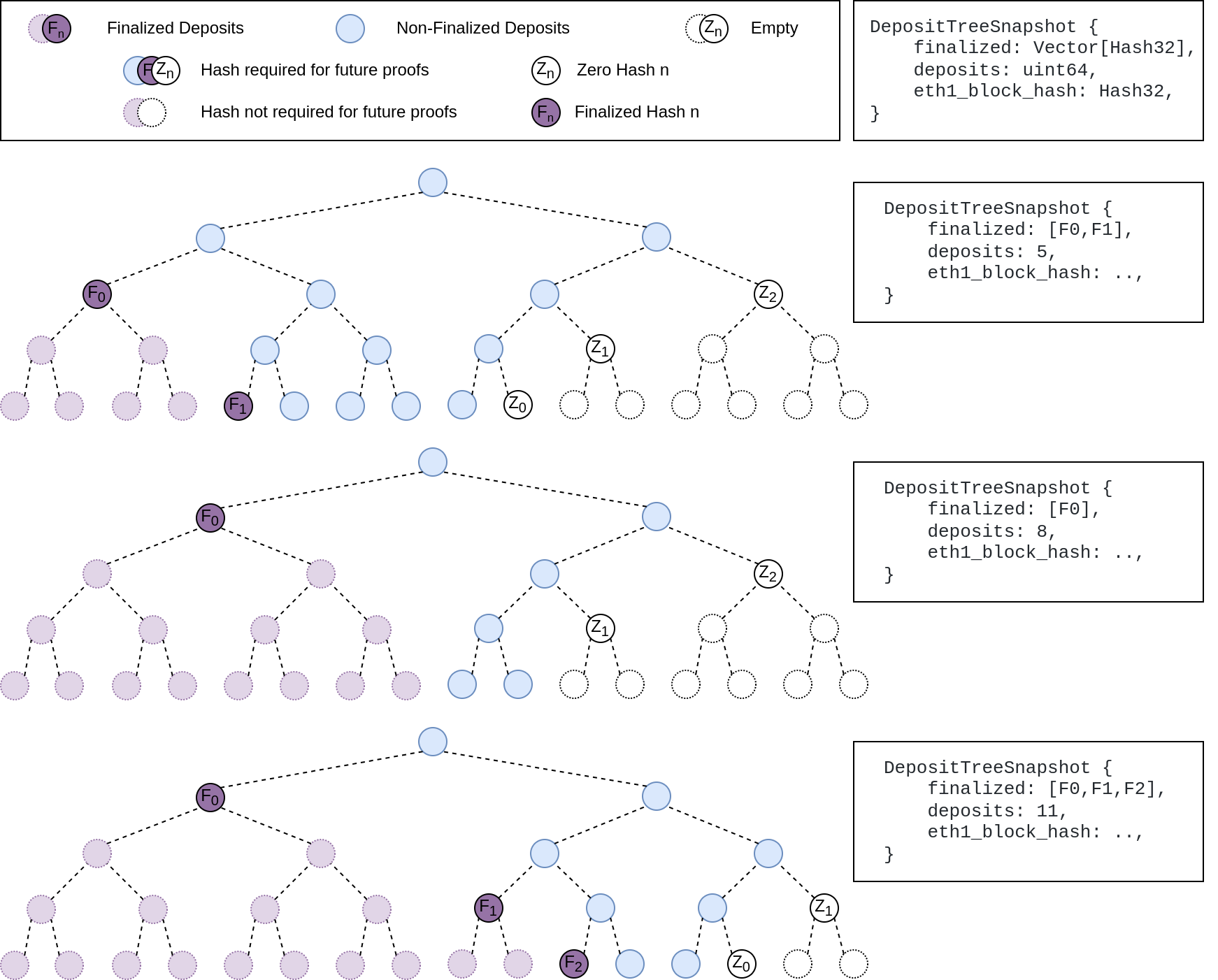
Image to illustrate how the deposit contract merkle tree evolves and finalizes along with the resulting `DepositTreeSnapshot`
## Other Considerations
I've changed the structure of the `SszDepositCache` so once you load & save your database from this version of lighthouse, you will no longer be able to load it from older versions.
Co-authored-by: ethDreamer <37123614+ethDreamer@users.noreply.github.com>
* add capella gossip boiler plate

* get everything compiling

Co-authored-by: realbigsean <sean@sigmaprime.io
Co-authored-by: Mark Mackey <mark@sigmaprime.io>

* small cleanup

* small cleanup

* cargo fix + some test cleanup

* improve block production

* add fixme for potential panic

Co-authored-by: Mark Mackey <mark@sigmaprime.io>
## Issue Addressed
Fix a bug in block production that results in blocks with 0 attestations during the first slot of an epoch.
The bug is marked by debug logs of the form:
> DEBG Discarding attestation because of missing ancestor, block_root: 0x3cc00d9c9e0883b2d0db8606278f2b8423d4902f9a1ee619258b5b60590e64f8, pivot_slot: 4042591
It occurs when trying to look up the shuffling decision root for an attestation from a slot which is prior to fork choice's finalized block. This happens frequently when proposing in the first slot of the epoch where we have:
- `current_epoch == n`
- `attestation.data.target.epoch == n - 1`
- attestation shuffling epoch `== n - 3` (decision block being the last block of `n - 3`)
- `state.finalized_checkpoint.epoch == n - 2` (first block of `n - 2` is finalized)
Hence the shuffling decision slot is out of range of the fork choice backwards iterator _by a single slot_.
Unfortunately this bug was hidden when we weren't pruning fork choice, and then reintroduced in v2.5.1 when we fixed the pruning (https://github.com/sigp/lighthouse/releases/tag/v2.5.1). There's no way to turn that off or disable the filtering in our current release, so we need a new release to fix this issue.
Fortunately, it also does not occur on every epoch boundary because of the gradual pruning of fork choice every 256 blocks (~8 epochs):
01e84b71f5/consensus/proto_array/src/proto_array_fork_choice.rs (L16)01e84b71f5/consensus/proto_array/src/proto_array.rs (L713-L716)
So the probability of proposing a 0-attestation block given a proposal assignment is approximately `1/32 * 1/8 = 0.39%`.
## Proposed Changes
- Load the block's shuffling ID from fork choice and verify it against the expected shuffling ID of the head state. This code was initially written before we had settled on a representation of shuffling IDs, so I think it's a nice simplification to make use of them here rather than more ad-hoc logic that fundamentally does the same thing.
## Additional Info
Thanks to @moshe-blox for noticing this issue and bringing it to our attention.
## Issue Addressed

Closes https://github.com/sigp/lighthouse/issues/2371

## Proposed Changes

Backport some changes from `tree-states` that remove duplicated calculations of the `proposer_index`.

With this change the proposer index should be calculated only once for each block, and then plumbed through to every place it is required.

## Additional Info

In future I hope to add more data to the consensus context that is cached on a per-epoch basis, like the effective balances of validators and the base rewards.

There are some other changes to remove indexing in tests that were also useful for `tree-states` (the `tree-states` types don't implement `Index`).
## Issue Addressed
fixes lints from the last rust release

## Proposed Changes
Fix the lints, most of the lints by `clippy::question-mark` are false positives in the form of https://github.com/rust-lang/rust-clippy/issues/9518 so it's allowed for now

## Additional Info
## Issue Addressed

NA

## Proposed Changes

This PR removes duplicated block root computation.

Computing the `SignedBeaconBlock::canonical_root` has become more expensive since the merge as we need to compute the merke root of each transaction inside an `ExecutionPayload`.

Computing the root for [a mainnet block](https://beaconcha.in/slot/4704236) is taking ~10ms on my i7-8700K CPU @ 3.70GHz (no sha extensions). Given that our median seen-to-imported time for blocks is presently 300-400ms, removing a few duplicated block roots (~30ms) could represent an easy 10% improvement. When we consider that the seen-to-imported times include operations *after* the block has been placed in the early attester cache, we could expect the 30ms to be more significant WRT our seen-to-attestable times.

## Additional Info

NA
## Issue Addressed

NA

## Proposed Changes

Fixes an issue introduced in #3574 where I erroneously assumed that a `crossbeam_channel` multiple receiver queue was a *broadcast* queue. This is incorrect, each message will be received by *only one* receiver. The effect of this mistake is these logs:

```
Sep 20 06:56:17.001 INFO Synced                                  slot: 4736079, block: 0xaa8a…180d, epoch: 148002, finalized_epoch: 148000, finalized_root: 0x2775…47f2, exec_hash: 0x2ca5…ffde (verified), peers: 6, service: slot_notifier
Sep 20 06:56:23.237 ERRO Unable to validate attestation          error: CommitteeCacheWait(RecvError), peer_id: 16Uiu2HAm2Jnnj8868tb7hCta1rmkXUf5YjqUH1YPj35DCwNyeEzs, type: "aggregated", slot: Slot(4736047), beacon_block_root: 0x88d318534b1010e0ebd79aed60b6b6da1d70357d72b271c01adf55c2b46206c1
```

## Additional Info

NA

