 c5c7476518
[EIP-3030]: https://eips.ethereum.org/EIPS/eip-3030 [Web3Signer]: https://consensys.github.io/web3signer/web3signer-eth2.html ## Issue Addressed Resolves #2498 ## Proposed Changes Allows the VC to call out to a [Web3Signer] remote signer to obtain signatures. ## Additional Info ### Making Signing Functions `async` To allow remote signing, I needed to make all the signing functions `async`. This caused a bit of noise where I had to convert iterators into `for` loops. In `duties_service.rs` there was a particularly tricky case where we couldn't hold a write-lock across an `await`, so I had to first take a read-lock, then grab a write-lock. ### Move Signing from Core Executor Whilst implementing this feature, I noticed that we signing was happening on the core tokio executor. I suspect this was causing the executor to temporarily lock and occasionally trigger some HTTP timeouts (and potentially SQL pool timeouts, but I can't verify this). Since moving all signing into blocking tokio tasks, I noticed a distinct drop in the "atttestations_http_get" metric on a Prater node: 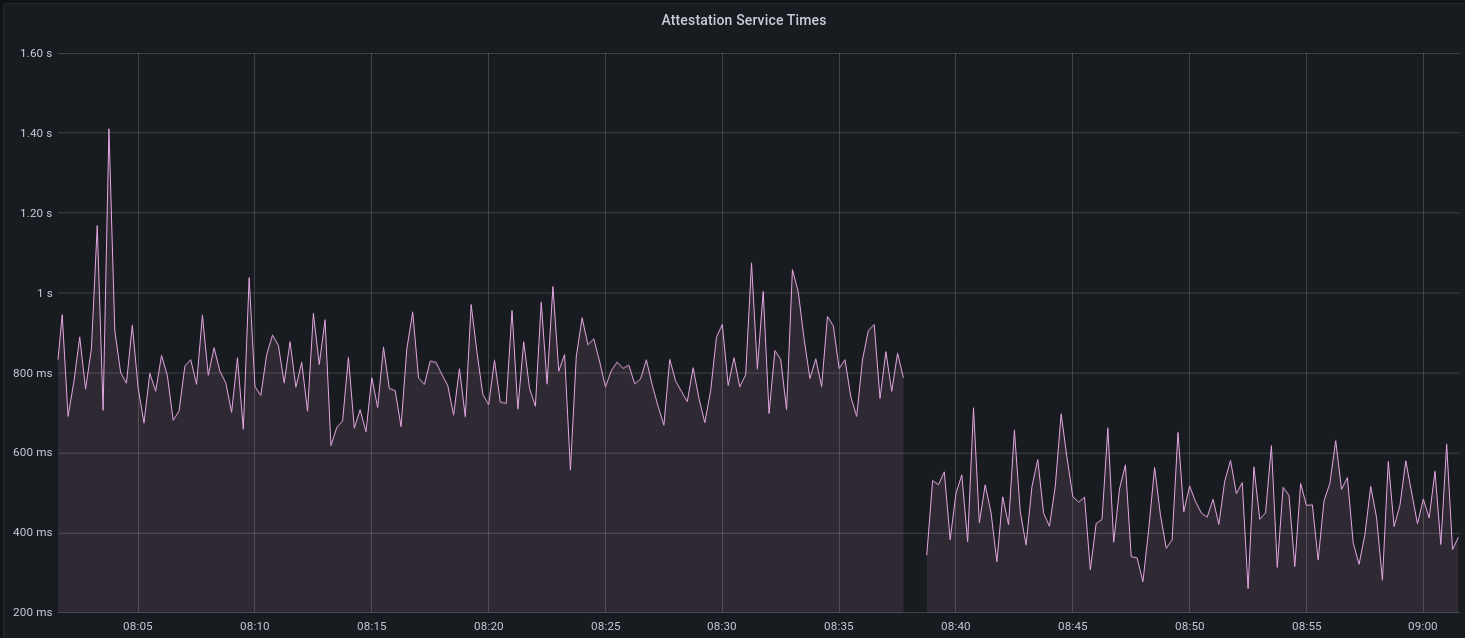 I think this graph indicates that freeing the core executor allows the VC to operate more smoothly. ### Refactor TaskExecutor I noticed that the `TaskExecutor::spawn_blocking_handle` function would fail to spawn tasks if it were unable to obtain handles to some metrics (this can happen if the same metric is defined twice). It seemed that a more sensible approach would be to keep spawning tasks, but without metrics. To that end, I refactored the function so that it would still function without metrics. There are no other changes made. ## TODO - [x] Restructure to support multiple signing methods. - [x] Add calls to remote signer from VC. - [x] Documentation - [x] Test all endpoints - [x] Test HTTPS certificate - [x] Allow adding remote signer validators via the API - [x] Add Altair support via [21.8.1-rc1](https://github.com/ConsenSys/web3signer/releases/tag/21.8.1-rc1) - [x] Create issue to start using latest version of web3signer. (See #2570) ## Notes - ~~Web3Signer doesn't yet support the Altair fork for Prater. See https://github.com/ConsenSys/web3signer/issues/423.~~ - ~~There is not yet a release of Web3Signer which supports Altair blocks. See https://github.com/ConsenSys/web3signer/issues/391.~~

2.6 KiB
Remote Signing with Web3Signer
Web3Signer is a tool by Consensys which allows remote signing. Remote signing is when a Validator Client (VC) out-sources the signing of messages to remote server (e.g., via HTTPS). This means that the VC does not hold the validator private keys.
Warnings
Using a remote signer comes with risks, please read the following two warnings before proceeding:
Remote signing is complex and risky
Remote signing is generally only desirable for enterprise users or users with unique security requirements. Most users will find the separation between the Beacon Node (BN) and VC to be sufficient without introducing a remote signer.
Using a remote signer introduces a new set of security and slashing risks and should only be undertaken by advanced users who fully understand the risks.
Web3Signer is not maintained by Lighthouse
The Web3Signer tool is maintained by Consensys, the same team that maintains Teku. The Lighthouse team (Sigma Prime) does not maintain Web3Signer or make any guarantees about its safety or effectiveness.
Usage
A remote signing validator is added to Lighthouse in much the same way as one that uses a local
keystore, via the validator_definitions.yml file or via the POST /lighthouse/validators/web3signer API endpoint.
Here is an example of a validator_definitions.yml file containing one validator which uses a
remote signer:
---
- enabled: true
  voting_public_key: "0xa5566f9ec3c6e1fdf362634ebec9ef7aceb0e460e5079714808388e5d48f4ae1e12897fed1bea951c17fa389d511e477"
  type: web3signer
  url: "https://my-remote-signer.com:1234"
  root_certificate_path: /home/paul/my-certificates/my-remote-signer.pem
When using this file, the Lighthouse VC will perform duties for the 0xa5566.. validator and defer
to the https://my-remote-signer.com:1234 server to obtain any signatures. It will load a
"self-signed" SSL certificate from /home/paul/my-certificates/my-remote-signer.pem (on the
filesystem of the VC) to encrypt the communications between the VC and Web3Signer.
The
request_timeout_mskey can also be specified. Use this key to override the default timeout with a new timeout in milliseconds. This is the timeout before requests to Web3Signer are considered to be failures. Setting a value that it too-long may create contention and late duties in the VC. Setting it too short will result in failed signatures and therefore missed duties.