mirror of
https://github.com/sigp/lighthouse.git
synced 2026-03-10 04:01:51 +00:00
 e8604757a2
## Summary The deposit cache now has the ability to finalize deposits. This will cause it to drop unneeded deposit logs and hashes in the deposit Merkle tree that are no longer required to construct deposit proofs. The cache is finalized whenever the latest finalized checkpoint has a new `Eth1Data` with all deposits imported. This has three benefits: 1. Improves the speed of constructing Merkle proofs for deposits as we can just replay deposits since the last finalized checkpoint instead of all historical deposits when re-constructing the Merkle tree. 2. Significantly faster weak subjectivity sync as the deposit cache can be transferred to the newly syncing node in compressed form. The Merkle tree that stores `N` finalized deposits requires a maximum of `log2(N)` hashes. The newly syncing node then only needs to download deposits since the last finalized checkpoint to have a full tree. 3. Future proofing in preparation for [EIP-4444](https://eips.ethereum.org/EIPS/eip-4444) as execution nodes will no longer be required to store logs permanently so we won't always have all historical logs available to us. ## More Details Image to illustrate how the deposit contract merkle tree evolves and finalizes along with the resulting `DepositTreeSnapshot` 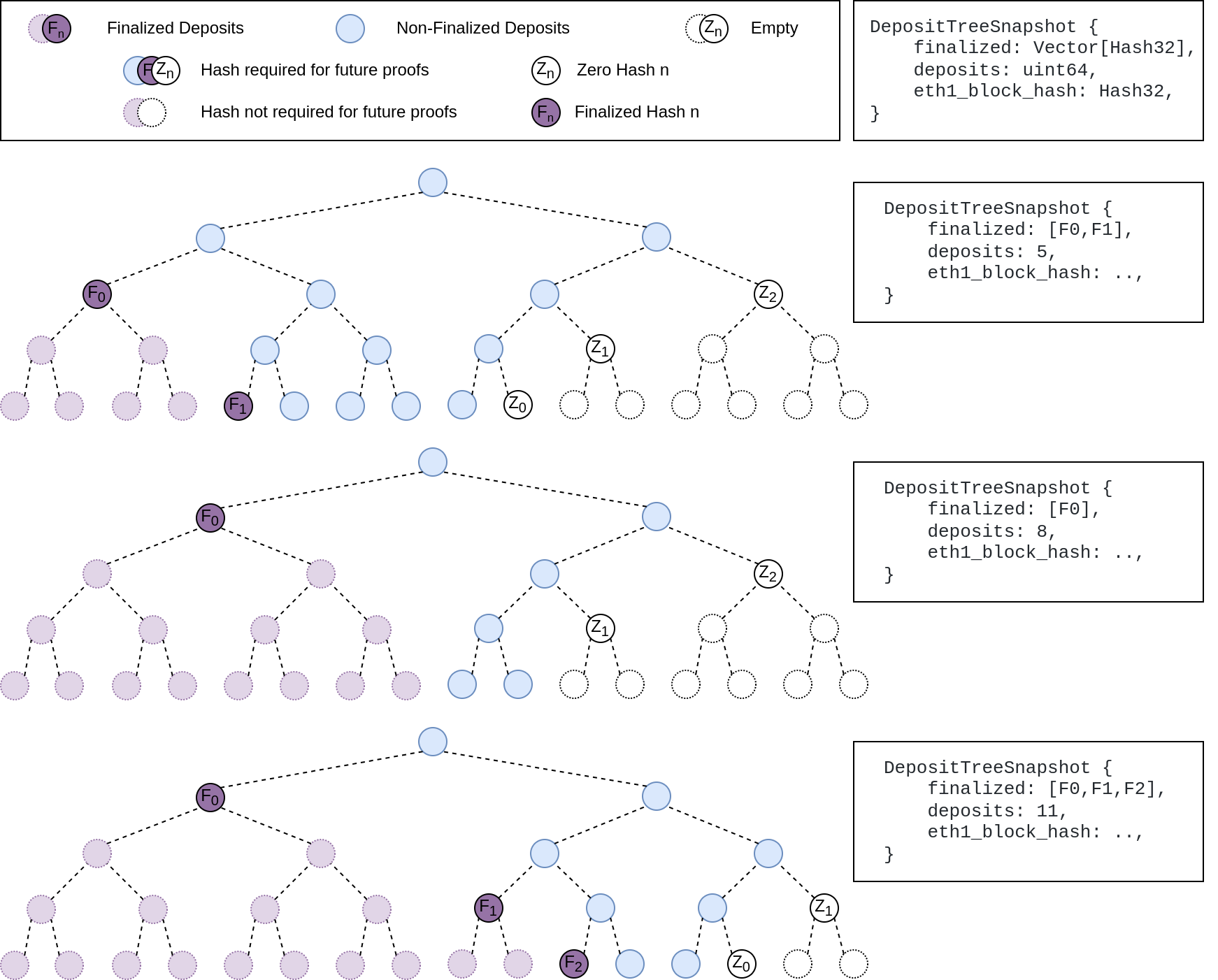 ## Other Considerations I've changed the structure of the `SszDepositCache` so once you load & save your database from this version of lighthouse, you will no longer be able to load it from older versions. Co-authored-by: ethDreamer <37123614+ethDreamer@users.noreply.github.com>

1208 lines
42 KiB
Rust
1208 lines
42 KiB
Rust
use crate::metrics;
|
|
use eth1::{Config as Eth1Config, Eth1Block, Service as HttpService};
|
|
use eth2::lighthouse::Eth1SyncStatusData;
|
|
use eth2_hashing::hash;
|
|
use int_to_bytes::int_to_bytes32;
|
|
use slog::{debug, error, trace, Logger};
|
|
use ssz::{Decode, Encode};
|
|
use ssz_derive::{Decode, Encode};
|
|
use state_processing::per_block_processing::get_new_eth1_data;
|
|
use std::cmp::Ordering;
|
|
use std::collections::HashMap;
|
|
use std::iter::DoubleEndedIterator;
|
|
use std::marker::PhantomData;
|
|
use std::time::{SystemTime, UNIX_EPOCH};
|
|
use store::{DBColumn, Error as StoreError, StoreItem};
|
|
use task_executor::TaskExecutor;
|
|
use types::{
|
|
BeaconState, BeaconStateError, ChainSpec, Deposit, Eth1Data, EthSpec, Hash256, Slot, Unsigned,
|
|
};
|
|
|
|
type BlockNumber = u64;
|
|
type Eth1DataVoteCount = HashMap<(Eth1Data, BlockNumber), u64>;
|
|
|
|
/// We will declare ourself synced with the Eth1 chain, even if we are this many blocks behind.
|
|
///
|
|
/// This number (8) was chosen somewhat arbitrarily.
|
|
const ETH1_SYNC_TOLERANCE: u64 = 8;
|
|
|
|
#[derive(Debug)]
|
|
pub enum Error {
|
|
/// Unable to return an Eth1Data for the given epoch.
|
|
EpochUnavailable,
|
|
/// An error from the backend service (e.g., the web3 data fetcher).
|
|
BackendError(String),
|
|
/// The deposit index of the state is higher than the deposit contract. This is a critical
|
|
/// consensus error.
|
|
DepositIndexTooHigh,
|
|
/// The current state was unable to return the root for the state at the start of the eth1
|
|
/// voting period.
|
|
UnableToGetPreviousStateRoot(BeaconStateError),
|
|
/// The state required to find the previous eth1 block was not found in the store.
|
|
PreviousStateNotInDB(Hash256),
|
|
/// There was an error accessing an object in the database.
|
|
StoreError(StoreError),
|
|
/// The eth1 head block at the start of the eth1 voting period is unknown.
|
|
///
|
|
/// The eth1 caches are likely stale.
|
|
UnknownVotingPeriodHead,
|
|
/// The block that was previously voted into the state is unknown.
|
|
///
|
|
/// The eth1 caches are stale, or a junk value was voted into the chain.
|
|
UnknownPreviousEth1BlockHash,
|
|
/// An arithmetic error occurred.
|
|
ArithError(safe_arith::ArithError),
|
|
}
|
|
|
|
impl From<safe_arith::ArithError> for Error {
|
|
fn from(e: safe_arith::ArithError) -> Self {
|
|
Self::ArithError(e)
|
|
}
|
|
}
|
|
|
|
/// Returns an `Eth1SyncStatusData` given some parameters:
|
|
///
|
|
/// - `latest_cached_block`: The latest eth1 block in our cache, if any.
|
|
/// - `head_block`: The block at the very head of our eth1 node (ignoring follow distance, etc).
|
|
/// - `genesis_time`: beacon chain genesis time.
|
|
/// - `current_slot`: current beacon chain slot.
|
|
/// - `spec`: current beacon chain specification.
|
|
fn get_sync_status<T: EthSpec>(
|
|
latest_cached_block: Option<&Eth1Block>,
|
|
head_block: Option<&Eth1Block>,
|
|
genesis_time: u64,
|
|
current_slot: Option<Slot>,
|
|
spec: &ChainSpec,
|
|
) -> Option<Eth1SyncStatusData> {
|
|
let eth1_follow_distance_seconds = spec
|
|
.seconds_per_eth1_block
|
|
.saturating_mul(spec.eth1_follow_distance);
|
|
|
|
// The voting target timestamp needs to be special-cased when we're before
|
|
// genesis (as defined by `current_slot == None`).
|
|
//
|
|
// For the sake of this status, when prior to genesis we want to invent some voting periods
|
|
// that are *before* genesis, so that we can indicate to users that we're actually adequately
|
|
// cached for where they are in time.
|
|
let voting_target_timestamp = if let Some(current_slot) = current_slot {
|
|
let period = T::SlotsPerEth1VotingPeriod::to_u64();
|
|
let voting_period_start_slot = (current_slot / period) * period;
|
|
|
|
let period_start = slot_start_seconds::<T>(
|
|
genesis_time,
|
|
spec.seconds_per_slot,
|
|
voting_period_start_slot,
|
|
);
|
|
|
|
period_start.saturating_sub(eth1_follow_distance_seconds)
|
|
} else {
|
|
// The number of seconds in an eth1 voting period.
|
|
let voting_period_duration =
|
|
T::slots_per_eth1_voting_period() as u64 * spec.seconds_per_slot;
|
|
|
|
let now = SystemTime::now().duration_since(UNIX_EPOCH).ok()?.as_secs();
|
|
|
|
// The number of seconds between now and genesis.
|
|
let seconds_till_genesis = genesis_time.saturating_sub(now);
|
|
|
|
// Determine how many voting periods are contained in distance between
|
|
// now and genesis, rounding up.
|
|
let voting_periods_past =
|
|
(seconds_till_genesis + voting_period_duration - 1) / voting_period_duration;
|
|
|
|
// Return the start time of the current voting period*.
|
|
//
|
|
// *: This voting period doesn't *actually* exist, we're just using it to
|
|
// give useful logs prior to genesis.
|
|
genesis_time
|
|
.saturating_sub(voting_periods_past * voting_period_duration)
|
|
.saturating_sub(eth1_follow_distance_seconds)
|
|
};
|
|
|
|
let latest_cached_block_number = latest_cached_block.map(|b| b.number);
|
|
let latest_cached_block_timestamp = latest_cached_block.map(|b| b.timestamp);
|
|
let head_block_number = head_block.map(|b| b.number);
|
|
let head_block_timestamp = head_block.map(|b| b.timestamp);
|
|
|
|
let eth1_node_sync_status_percentage = if let Some(head_block) = head_block {
|
|
let now = SystemTime::now().duration_since(UNIX_EPOCH).ok()?.as_secs();
|
|
let head_age = now.saturating_sub(head_block.timestamp);
|
|
|
|
if head_age < ETH1_SYNC_TOLERANCE * spec.seconds_per_eth1_block {
|
|
// Always indicate we are fully synced if it's within the sync threshold.
|
|
100.0
|
|
} else {
|
|
let blocks_behind = head_age
|
|
.checked_div(spec.seconds_per_eth1_block)
|
|
.unwrap_or(0);
|
|
|
|
let part = f64::from(head_block.number as u32);
|
|
let whole = f64::from(head_block.number.saturating_add(blocks_behind) as u32);
|
|
|
|
if whole > 0.0 {
|
|
(part / whole) * 100.0
|
|
} else {
|
|
// Avoids a divide-by-zero.
|
|
0.0
|
|
}
|
|
}
|
|
} else {
|
|
// Always return 0% synced if the head block of the eth1 chain is unknown.
|
|
0.0
|
|
};
|
|
|
|
// Lighthouse is "cached and ready" when it has cached enough blocks to cover the start of the
|
|
// current voting period.
|
|
let lighthouse_is_cached_and_ready =
|
|
latest_cached_block_timestamp.map_or(false, |t| t >= voting_target_timestamp);
|
|
|
|
Some(Eth1SyncStatusData {
|
|
head_block_number,
|
|
head_block_timestamp,
|
|
latest_cached_block_number,
|
|
latest_cached_block_timestamp,
|
|
voting_target_timestamp,
|
|
eth1_node_sync_status_percentage,
|
|
lighthouse_is_cached_and_ready,
|
|
})
|
|
}
|
|
|
|
#[derive(Encode, Decode, Clone)]
|
|
pub struct SszEth1 {
|
|
pub use_dummy_backend: bool,
|
|
pub backend_bytes: Vec<u8>,
|
|
}
|
|
|
|
impl StoreItem for SszEth1 {
|
|
fn db_column() -> DBColumn {
|
|
DBColumn::Eth1Cache
|
|
}
|
|
|
|
fn as_store_bytes(&self) -> Vec<u8> {
|
|
self.as_ssz_bytes()
|
|
}
|
|
|
|
fn from_store_bytes(bytes: &[u8]) -> Result<Self, StoreError> {
|
|
Self::from_ssz_bytes(bytes).map_err(Into::into)
|
|
}
|
|
}
|
|
|
|
/// Holds an `Eth1ChainBackend` and serves requests from the `BeaconChain`.
|
|
pub struct Eth1Chain<T, E>
|
|
where
|
|
T: Eth1ChainBackend<E>,
|
|
E: EthSpec,
|
|
{
|
|
backend: T,
|
|
/// When `true`, the backend will be ignored and dummy data from the 2019 Canada interop method
|
|
/// will be used instead.
|
|
use_dummy_backend: bool,
|
|
_phantom: PhantomData<E>,
|
|
}
|
|
|
|
impl<T, E> Eth1Chain<T, E>
|
|
where
|
|
T: Eth1ChainBackend<E>,
|
|
E: EthSpec,
|
|
{
|
|
pub fn new(backend: T) -> Self {
|
|
Self {
|
|
backend,
|
|
use_dummy_backend: false,
|
|
_phantom: PhantomData,
|
|
}
|
|
}
|
|
|
|
pub fn new_dummy(backend: T) -> Self {
|
|
Self {
|
|
use_dummy_backend: true,
|
|
..Self::new(backend)
|
|
}
|
|
}
|
|
|
|
/// Returns `true` if the "dummy" backend is being used.
|
|
pub fn is_dummy_backend(&self) -> bool {
|
|
self.use_dummy_backend
|
|
}
|
|
|
|
/// Returns the `Eth1Data` that should be included in a block being produced for the given
|
|
/// `state`.
|
|
pub fn eth1_data_for_block_production(
|
|
&self,
|
|
state: &BeaconState<E>,
|
|
spec: &ChainSpec,
|
|
) -> Result<Eth1Data, Error> {
|
|
if self.use_dummy_backend {
|
|
let dummy_backend: DummyEth1ChainBackend<E> = DummyEth1ChainBackend::default();
|
|
dummy_backend.eth1_data(state, spec)
|
|
} else {
|
|
self.backend.eth1_data(state, spec)
|
|
}
|
|
}
|
|
|
|
/// Returns a list of `Deposits` that may be included in a block.
|
|
///
|
|
/// Including all of the returned `Deposits` in a block should _not_ cause it to become
|
|
/// invalid (i.e., this function should respect the maximum).
|
|
///
|
|
/// `eth1_data_vote` is the `Eth1Data` that the block producer would include in their
|
|
/// block. This vote may change the `state.eth1_data` value, which would change the deposit
|
|
/// count and therefore change the output of this function.
|
|
pub fn deposits_for_block_inclusion(
|
|
&self,
|
|
state: &BeaconState<E>,
|
|
eth1_data_vote: &Eth1Data,
|
|
spec: &ChainSpec,
|
|
) -> Result<Vec<Deposit>, Error> {
|
|
if self.use_dummy_backend {
|
|
let dummy_backend: DummyEth1ChainBackend<E> = DummyEth1ChainBackend::default();
|
|
dummy_backend.queued_deposits(state, eth1_data_vote, spec)
|
|
} else {
|
|
self.backend.queued_deposits(state, eth1_data_vote, spec)
|
|
}
|
|
}
|
|
|
|
/// Returns a status indicating how synced our caches are with the eth1 chain.
|
|
pub fn sync_status(
|
|
&self,
|
|
genesis_time: u64,
|
|
current_slot: Option<Slot>,
|
|
spec: &ChainSpec,
|
|
) -> Option<Eth1SyncStatusData> {
|
|
get_sync_status::<E>(
|
|
self.backend.latest_cached_block().as_ref(),
|
|
self.backend.head_block().as_ref(),
|
|
genesis_time,
|
|
current_slot,
|
|
spec,
|
|
)
|
|
}
|
|
|
|
/// Instantiate `Eth1Chain` from a persisted `SszEth1`.
|
|
///
|
|
/// The `Eth1Chain` will have the same caches as the persisted `SszEth1`.
|
|
pub fn from_ssz_container(
|
|
ssz_container: &SszEth1,
|
|
config: Eth1Config,
|
|
log: &Logger,
|
|
spec: ChainSpec,
|
|
) -> Result<Self, String> {
|
|
let backend =
|
|
Eth1ChainBackend::from_bytes(&ssz_container.backend_bytes, config, log.clone(), spec)?;
|
|
Ok(Self {
|
|
use_dummy_backend: ssz_container.use_dummy_backend,
|
|
backend,
|
|
_phantom: PhantomData,
|
|
})
|
|
}
|
|
|
|
/// Return a `SszEth1` containing the state of `Eth1Chain`.
|
|
pub fn as_ssz_container(&self) -> SszEth1 {
|
|
SszEth1 {
|
|
use_dummy_backend: self.use_dummy_backend,
|
|
backend_bytes: self.backend.as_bytes(),
|
|
}
|
|
}
|
|
|
|
/// Set in motion the finalization of `Eth1Data`. This method is called during block import
|
|
/// so it should be fast.
|
|
pub fn finalize_eth1_data(&self, eth1_data: Eth1Data) {
|
|
self.backend.finalize_eth1_data(eth1_data);
|
|
}
|
|
|
|
/// Consumes `self`, returning the backend.
|
|
pub fn into_backend(self) -> T {
|
|
self.backend
|
|
}
|
|
}
|
|
|
|
pub trait Eth1ChainBackend<T: EthSpec>: Sized + Send + Sync {
|
|
/// Returns the `Eth1Data` that should be included in a block being produced for the given
|
|
/// `state`.
|
|
fn eth1_data(&self, beacon_state: &BeaconState<T>, spec: &ChainSpec)
|
|
-> Result<Eth1Data, Error>;
|
|
|
|
/// Returns all `Deposits` between `state.eth1_deposit_index` and
|
|
/// `state.eth1_data.deposit_count`.
|
|
///
|
|
/// # Note:
|
|
///
|
|
/// It is possible that not all returned `Deposits` can be included in a block. E.g., there may
|
|
/// be more than `MAX_DEPOSIT_COUNT` or the churn may be too high.
|
|
fn queued_deposits(
|
|
&self,
|
|
beacon_state: &BeaconState<T>,
|
|
eth1_data_vote: &Eth1Data,
|
|
spec: &ChainSpec,
|
|
) -> Result<Vec<Deposit>, Error>;
|
|
|
|
/// Returns the latest block stored in the cache. Used to obtain an idea of how up-to-date the
|
|
/// beacon node eth1 cache is.
|
|
fn latest_cached_block(&self) -> Option<Eth1Block>;
|
|
|
|
/// Set in motion the finalization of `Eth1Data`. This method is called during block import
|
|
/// so it should be fast.
|
|
fn finalize_eth1_data(&self, eth1_data: Eth1Data);
|
|
|
|
/// Returns the block at the head of the chain (ignoring follow distance, etc). Used to obtain
|
|
/// an idea of how up-to-date the remote eth1 node is.
|
|
fn head_block(&self) -> Option<Eth1Block>;
|
|
|
|
/// Encode the `Eth1ChainBackend` instance to bytes.
|
|
fn as_bytes(&self) -> Vec<u8>;
|
|
|
|
/// Create a `Eth1ChainBackend` instance given encoded bytes.
|
|
fn from_bytes(
|
|
bytes: &[u8],
|
|
config: Eth1Config,
|
|
log: Logger,
|
|
spec: ChainSpec,
|
|
) -> Result<Self, String>;
|
|
}
|
|
|
|
/// Provides a simple, testing-only backend that generates deterministic, meaningless eth1 data.
|
|
///
|
|
/// Never creates deposits, therefore the validator set is static.
|
|
///
|
|
/// This was used in the 2019 Canada interop workshops.
|
|
pub struct DummyEth1ChainBackend<T: EthSpec>(PhantomData<T>);
|
|
|
|
impl<T: EthSpec> Eth1ChainBackend<T> for DummyEth1ChainBackend<T> {
|
|
/// Produce some deterministic junk based upon the current epoch.
|
|
fn eth1_data(&self, state: &BeaconState<T>, _spec: &ChainSpec) -> Result<Eth1Data, Error> {
|
|
let current_epoch = state.current_epoch();
|
|
let slots_per_voting_period = T::slots_per_eth1_voting_period() as u64;
|
|
let current_voting_period: u64 = current_epoch.as_u64() / slots_per_voting_period;
|
|
|
|
let deposit_root = hash(&int_to_bytes32(current_voting_period));
|
|
let block_hash = hash(&deposit_root);
|
|
|
|
Ok(Eth1Data {
|
|
deposit_root: Hash256::from_slice(&deposit_root),
|
|
deposit_count: state.eth1_deposit_index(),
|
|
block_hash: Hash256::from_slice(&block_hash),
|
|
})
|
|
}
|
|
|
|
/// The dummy back-end never produces deposits.
|
|
fn queued_deposits(
|
|
&self,
|
|
_: &BeaconState<T>,
|
|
_: &Eth1Data,
|
|
_: &ChainSpec,
|
|
) -> Result<Vec<Deposit>, Error> {
|
|
Ok(vec![])
|
|
}
|
|
|
|
fn latest_cached_block(&self) -> Option<Eth1Block> {
|
|
None
|
|
}
|
|
|
|
fn finalize_eth1_data(&self, _eth1_data: Eth1Data) {}
|
|
|
|
fn head_block(&self) -> Option<Eth1Block> {
|
|
None
|
|
}
|
|
|
|
/// Return empty Vec<u8> for dummy backend.
|
|
fn as_bytes(&self) -> Vec<u8> {
|
|
Vec::new()
|
|
}
|
|
|
|
/// Create dummy eth1 backend.
|
|
fn from_bytes(
|
|
_bytes: &[u8],
|
|
_config: Eth1Config,
|
|
_log: Logger,
|
|
_spec: ChainSpec,
|
|
) -> Result<Self, String> {
|
|
Ok(Self(PhantomData))
|
|
}
|
|
}
|
|
|
|
impl<T: EthSpec> Default for DummyEth1ChainBackend<T> {
|
|
fn default() -> Self {
|
|
Self(PhantomData)
|
|
}
|
|
}
|
|
|
|
/// Maintains a cache of eth1 blocks and deposits and provides functions to allow block producers
|
|
/// to include new deposits and vote on `Eth1Data`.
|
|
///
|
|
/// The `core` connects to some external eth1 client (e.g., Parity/Geth) and polls it for
|
|
/// information.
|
|
#[derive(Clone)]
|
|
pub struct CachingEth1Backend<T: EthSpec> {
|
|
pub core: HttpService,
|
|
log: Logger,
|
|
_phantom: PhantomData<T>,
|
|
}
|
|
|
|
impl<T: EthSpec> CachingEth1Backend<T> {
|
|
/// Instantiates `self` with empty caches.
|
|
///
|
|
/// Does not connect to the eth1 node or start any tasks to keep the cache updated.
|
|
pub fn new(config: Eth1Config, log: Logger, spec: ChainSpec) -> Result<Self, String> {
|
|
Ok(Self {
|
|
core: HttpService::new(config, log.clone(), spec)
|
|
.map_err(|e| format!("Failed to create eth1 http service: {:?}", e))?,
|
|
log,
|
|
_phantom: PhantomData,
|
|
})
|
|
}
|
|
|
|
/// Starts the routine which connects to the external eth1 node and updates the caches.
|
|
pub fn start(&self, handle: TaskExecutor) {
|
|
HttpService::auto_update(self.core.clone(), handle);
|
|
}
|
|
|
|
/// Instantiates `self` from an existing service.
|
|
pub fn from_service(service: HttpService) -> Self {
|
|
Self {
|
|
log: service.log.clone(),
|
|
core: service,
|
|
_phantom: PhantomData,
|
|
}
|
|
}
|
|
}
|
|
|
|
impl<T: EthSpec> Eth1ChainBackend<T> for CachingEth1Backend<T> {
|
|
fn eth1_data(&self, state: &BeaconState<T>, spec: &ChainSpec) -> Result<Eth1Data, Error> {
|
|
let period = T::SlotsPerEth1VotingPeriod::to_u64();
|
|
let voting_period_start_slot = (state.slot() / period) * period;
|
|
let voting_period_start_seconds = slot_start_seconds::<T>(
|
|
state.genesis_time(),
|
|
spec.seconds_per_slot,
|
|
voting_period_start_slot,
|
|
);
|
|
|
|
let blocks = self.core.blocks().read();
|
|
|
|
let votes_to_consider =
|
|
get_votes_to_consider(blocks.iter(), voting_period_start_seconds, spec);
|
|
|
|
trace!(
|
|
self.log,
|
|
"Found eth1 data votes_to_consider";
|
|
"votes_to_consider" => votes_to_consider.len(),
|
|
);
|
|
let valid_votes = collect_valid_votes(state, &votes_to_consider);
|
|
|
|
let eth1_data = if let Some(eth1_data) = find_winning_vote(valid_votes) {
|
|
eth1_data
|
|
} else {
|
|
// In this case, there are no valid votes available.
|
|
//
|
|
// Here we choose the eth1_data corresponding to the latest block in our voting window.
|
|
// If no votes exist, choose `state.eth1_data` as default vote.
|
|
votes_to_consider
|
|
.iter()
|
|
.max_by_key(|(_, block_number)| *block_number)
|
|
.map(|vote| {
|
|
let vote = vote.0.clone();
|
|
debug!(
|
|
self.log,
|
|
"No valid eth1_data votes";
|
|
"outcome" => "Casting vote corresponding to last candidate eth1 block",
|
|
"vote" => ?vote
|
|
);
|
|
vote
|
|
})
|
|
.unwrap_or_else(|| {
|
|
let vote = state.eth1_data().clone();
|
|
error!(
|
|
self.log,
|
|
"No valid eth1_data votes, `votes_to_consider` empty";
|
|
"lowest_block_number" => self.core.lowest_block_number(),
|
|
"earliest_block_timestamp" => self.core.earliest_block_timestamp(),
|
|
"genesis_time" => state.genesis_time(),
|
|
"outcome" => "casting `state.eth1_data` as eth1 vote"
|
|
);
|
|
metrics::inc_counter(&metrics::DEFAULT_ETH1_VOTES);
|
|
vote
|
|
})
|
|
};
|
|
|
|
debug!(
|
|
self.log,
|
|
"Produced vote for eth1 chain";
|
|
"deposit_root" => format!("{:?}", eth1_data.deposit_root),
|
|
"deposit_count" => eth1_data.deposit_count,
|
|
"block_hash" => format!("{:?}", eth1_data.block_hash),
|
|
);
|
|
|
|
Ok(eth1_data)
|
|
}
|
|
|
|
fn queued_deposits(
|
|
&self,
|
|
state: &BeaconState<T>,
|
|
eth1_data_vote: &Eth1Data,
|
|
_spec: &ChainSpec,
|
|
) -> Result<Vec<Deposit>, Error> {
|
|
let deposit_index = state.eth1_deposit_index();
|
|
let deposit_count = if let Some(new_eth1_data) = get_new_eth1_data(state, eth1_data_vote)? {
|
|
new_eth1_data.deposit_count
|
|
} else {
|
|
state.eth1_data().deposit_count
|
|
};
|
|
|
|
match deposit_index.cmp(&deposit_count) {
|
|
Ordering::Greater => Err(Error::DepositIndexTooHigh),
|
|
Ordering::Equal => Ok(vec![]),
|
|
Ordering::Less => {
|
|
let next = deposit_index;
|
|
let last = std::cmp::min(deposit_count, next + T::MaxDeposits::to_u64());
|
|
|
|
self.core
|
|
.deposits()
|
|
.read()
|
|
.cache
|
|
.get_deposits(next, last, deposit_count)
|
|
.map_err(|e| Error::BackendError(format!("Failed to get deposits: {:?}", e)))
|
|
.map(|(_deposit_root, deposits)| deposits)
|
|
}
|
|
}
|
|
}
|
|
|
|
fn latest_cached_block(&self) -> Option<Eth1Block> {
|
|
self.core.latest_cached_block()
|
|
}
|
|
|
|
/// This only writes the eth1_data to a temporary cache so that the service
|
|
/// thread can later do the actual finalizing of the deposit tree.
|
|
fn finalize_eth1_data(&self, eth1_data: Eth1Data) {
|
|
self.core.set_to_finalize(Some(eth1_data));
|
|
}
|
|
|
|
fn head_block(&self) -> Option<Eth1Block> {
|
|
self.core.head_block()
|
|
}
|
|
|
|
/// Return encoded byte representation of the block and deposit caches.
|
|
fn as_bytes(&self) -> Vec<u8> {
|
|
self.core.as_bytes()
|
|
}
|
|
|
|
/// Recover the cached backend from encoded bytes.
|
|
fn from_bytes(
|
|
bytes: &[u8],
|
|
config: Eth1Config,
|
|
log: Logger,
|
|
spec: ChainSpec,
|
|
) -> Result<Self, String> {
|
|
let inner = HttpService::from_bytes(bytes, config, log.clone(), spec)?;
|
|
Ok(Self {
|
|
core: inner,
|
|
log,
|
|
_phantom: PhantomData,
|
|
})
|
|
}
|
|
}
|
|
|
|
/// Get all votes from eth1 blocks which are in the list of candidate blocks for the
|
|
/// current eth1 voting period.
|
|
///
|
|
/// Returns a hashmap of `Eth1Data` to its associated eth1 `block_number`.
|
|
fn get_votes_to_consider<'a, I>(
|
|
blocks: I,
|
|
voting_period_start_seconds: u64,
|
|
spec: &ChainSpec,
|
|
) -> HashMap<Eth1Data, u64>
|
|
where
|
|
I: DoubleEndedIterator<Item = &'a Eth1Block> + Clone,
|
|
{
|
|
blocks
|
|
.rev()
|
|
.skip_while(|eth1_block| !is_candidate_block(eth1_block, voting_period_start_seconds, spec))
|
|
.take_while(|eth1_block| is_candidate_block(eth1_block, voting_period_start_seconds, spec))
|
|
.filter_map(|eth1_block| {
|
|
eth1_block
|
|
.clone()
|
|
.eth1_data()
|
|
.map(|eth1_data| (eth1_data, eth1_block.number))
|
|
})
|
|
.collect()
|
|
}
|
|
|
|
/// Collect all valid votes that are cast during the current voting period.
|
|
/// Return hashmap with count of each vote cast.
|
|
fn collect_valid_votes<T: EthSpec>(
|
|
state: &BeaconState<T>,
|
|
votes_to_consider: &HashMap<Eth1Data, BlockNumber>,
|
|
) -> Eth1DataVoteCount {
|
|
let mut valid_votes = HashMap::new();
|
|
state
|
|
.eth1_data_votes()
|
|
.iter()
|
|
.filter_map(|vote| {
|
|
votes_to_consider
|
|
.get(vote)
|
|
.map(|block_num| (vote.clone(), *block_num))
|
|
})
|
|
.for_each(|(eth1_data, block_number)| {
|
|
valid_votes
|
|
.entry((eth1_data, block_number))
|
|
.and_modify(|count| *count += 1)
|
|
.or_insert(1_u64);
|
|
});
|
|
valid_votes
|
|
}
|
|
|
|
/// Selects the winning vote from `valid_votes`.
|
|
fn find_winning_vote(valid_votes: Eth1DataVoteCount) -> Option<Eth1Data> {
|
|
valid_votes
|
|
.iter()
|
|
.max_by_key(|((_eth1_data, block_number), vote_count)| (*vote_count, block_number))
|
|
.map(|((eth1_data, _), _)| eth1_data.clone())
|
|
}
|
|
|
|
/// Returns the unix-epoch seconds at the start of the given `slot`.
|
|
fn slot_start_seconds<T: EthSpec>(
|
|
genesis_unix_seconds: u64,
|
|
seconds_per_slot: u64,
|
|
slot: Slot,
|
|
) -> u64 {
|
|
genesis_unix_seconds + slot.as_u64() * seconds_per_slot
|
|
}
|
|
|
|
/// Returns a boolean denoting if a given `Eth1Block` is a candidate for `Eth1Data` calculation
|
|
/// at the timestamp `period_start`.
|
|
///
|
|
/// Note: `period_start` needs to be atleast (`spec.seconds_per_eth1_block * spec.eth1_follow_distance * 2`)
|
|
/// for this function to return meaningful values.
|
|
fn is_candidate_block(block: &Eth1Block, period_start: u64, spec: &ChainSpec) -> bool {
|
|
block.timestamp
|
|
<= period_start.saturating_sub(spec.seconds_per_eth1_block * spec.eth1_follow_distance)
|
|
&& block.timestamp
|
|
>= period_start
|
|
.saturating_sub(spec.seconds_per_eth1_block * spec.eth1_follow_distance * 2)
|
|
}
|
|
|
|
#[cfg(test)]
|
|
mod test {
|
|
use super::*;
|
|
use environment::null_logger;
|
|
use types::{DepositData, MinimalEthSpec, Signature};
|
|
|
|
type E = MinimalEthSpec;
|
|
|
|
fn get_eth1_data(i: u64) -> Eth1Data {
|
|
Eth1Data {
|
|
block_hash: Hash256::from_low_u64_be(i),
|
|
deposit_root: Hash256::from_low_u64_be(u64::max_value() - i),
|
|
deposit_count: i,
|
|
}
|
|
}
|
|
|
|
fn get_voting_period_start_seconds(state: &BeaconState<E>, spec: &ChainSpec) -> u64 {
|
|
let period = <E as EthSpec>::SlotsPerEth1VotingPeriod::to_u64();
|
|
let voting_period_start_slot = (state.slot() / period) * period;
|
|
slot_start_seconds::<E>(
|
|
state.genesis_time(),
|
|
spec.seconds_per_slot,
|
|
voting_period_start_slot,
|
|
)
|
|
}
|
|
|
|
#[test]
|
|
fn slot_start_time() {
|
|
let zero_sec = 0;
|
|
assert_eq!(slot_start_seconds::<E>(100, zero_sec, Slot::new(2)), 100);
|
|
|
|
let one_sec = 1;
|
|
assert_eq!(slot_start_seconds::<E>(100, one_sec, Slot::new(0)), 100);
|
|
assert_eq!(slot_start_seconds::<E>(100, one_sec, Slot::new(1)), 101);
|
|
assert_eq!(slot_start_seconds::<E>(100, one_sec, Slot::new(2)), 102);
|
|
|
|
let three_sec = 3;
|
|
assert_eq!(slot_start_seconds::<E>(100, three_sec, Slot::new(0)), 100);
|
|
assert_eq!(slot_start_seconds::<E>(100, three_sec, Slot::new(1)), 103);
|
|
assert_eq!(slot_start_seconds::<E>(100, three_sec, Slot::new(2)), 106);
|
|
|
|
let five_sec = 5;
|
|
assert_eq!(slot_start_seconds::<E>(100, five_sec, Slot::new(0)), 100);
|
|
assert_eq!(slot_start_seconds::<E>(100, five_sec, Slot::new(1)), 105);
|
|
assert_eq!(slot_start_seconds::<E>(100, five_sec, Slot::new(2)), 110);
|
|
assert_eq!(slot_start_seconds::<E>(100, five_sec, Slot::new(3)), 115);
|
|
}
|
|
|
|
fn get_eth1_block(timestamp: u64, number: u64) -> Eth1Block {
|
|
Eth1Block {
|
|
number,
|
|
timestamp,
|
|
hash: Hash256::from_low_u64_be(number),
|
|
deposit_root: Some(Hash256::from_low_u64_be(number)),
|
|
deposit_count: Some(number),
|
|
}
|
|
}
|
|
|
|
mod eth1_chain_json_backend {
|
|
use super::*;
|
|
use eth1::DepositLog;
|
|
use types::{test_utils::generate_deterministic_keypair, EthSpec, MainnetEthSpec};
|
|
|
|
fn get_eth1_chain() -> Eth1Chain<CachingEth1Backend<E>, E> {
|
|
let eth1_config = Eth1Config {
|
|
..Eth1Config::default()
|
|
};
|
|
|
|
let log = null_logger().unwrap();
|
|
Eth1Chain::new(
|
|
CachingEth1Backend::new(eth1_config, log, MainnetEthSpec::default_spec()).unwrap(),
|
|
)
|
|
}
|
|
|
|
fn get_deposit_log(i: u64, spec: &ChainSpec) -> DepositLog {
|
|
let keypair = generate_deterministic_keypair(i as usize);
|
|
let mut deposit = DepositData {
|
|
pubkey: keypair.pk.into(),
|
|
withdrawal_credentials: Hash256::zero(),
|
|
amount: spec.max_effective_balance,
|
|
signature: Signature::empty().into(),
|
|
};
|
|
|
|
deposit.signature = deposit.create_signature(&keypair.sk, &E::default_spec());
|
|
|
|
DepositLog {
|
|
deposit_data: deposit,
|
|
block_number: i,
|
|
index: i,
|
|
signature_is_valid: true,
|
|
}
|
|
}
|
|
|
|
#[test]
|
|
fn deposits_empty_cache() {
|
|
let spec = &E::default_spec();
|
|
|
|
let eth1_chain = get_eth1_chain();
|
|
|
|
assert!(
|
|
!eth1_chain.use_dummy_backend,
|
|
"test should not use dummy backend"
|
|
);
|
|
|
|
let mut state: BeaconState<E> = BeaconState::new(0, get_eth1_data(0), spec);
|
|
*state.eth1_deposit_index_mut() = 0;
|
|
state.eth1_data_mut().deposit_count = 0;
|
|
|
|
assert!(
|
|
eth1_chain
|
|
.deposits_for_block_inclusion(&state, &Eth1Data::default(), spec)
|
|
.is_ok(),
|
|
"should succeed if cache is empty but no deposits are required"
|
|
);
|
|
|
|
state.eth1_data_mut().deposit_count = 1;
|
|
|
|
assert!(
|
|
eth1_chain
|
|
.deposits_for_block_inclusion(&state, &Eth1Data::default(), spec)
|
|
.is_err(),
|
|
"should fail to get deposits if required, but cache is empty"
|
|
);
|
|
}
|
|
|
|
#[test]
|
|
fn deposits_with_cache() {
|
|
let spec = &E::default_spec();
|
|
|
|
let eth1_chain = get_eth1_chain();
|
|
let max_deposits = <E as EthSpec>::MaxDeposits::to_u64();
|
|
|
|
assert!(
|
|
!eth1_chain.use_dummy_backend,
|
|
"test should not use dummy backend"
|
|
);
|
|
|
|
let deposits: Vec<_> = (0..max_deposits + 2)
|
|
.map(|i| get_deposit_log(i, spec))
|
|
.inspect(|log| {
|
|
eth1_chain
|
|
.backend
|
|
.core
|
|
.deposits()
|
|
.write()
|
|
.cache
|
|
.insert_log(log.clone())
|
|
.expect("should insert log");
|
|
})
|
|
.collect();
|
|
|
|
assert_eq!(
|
|
eth1_chain.backend.core.deposits().write().cache.len(),
|
|
deposits.len(),
|
|
"cache should store all logs"
|
|
);
|
|
|
|
let mut state: BeaconState<E> = BeaconState::new(0, get_eth1_data(0), spec);
|
|
*state.eth1_deposit_index_mut() = 0;
|
|
state.eth1_data_mut().deposit_count = 0;
|
|
|
|
assert!(
|
|
eth1_chain
|
|
.deposits_for_block_inclusion(&state, &Eth1Data::default(), spec)
|
|
.is_ok(),
|
|
"should succeed if no deposits are required"
|
|
);
|
|
|
|
(0..3).for_each(|initial_deposit_index| {
|
|
*state.eth1_deposit_index_mut() = initial_deposit_index as u64;
|
|
|
|
(initial_deposit_index..deposits.len()).for_each(|i| {
|
|
state.eth1_data_mut().deposit_count = i as u64;
|
|
|
|
let deposits_for_inclusion = eth1_chain
|
|
.deposits_for_block_inclusion(&state, &Eth1Data::default(), spec)
|
|
.unwrap_or_else(|_| panic!("should find deposit for {}", i));
|
|
|
|
let expected_len =
|
|
std::cmp::min(i - initial_deposit_index, max_deposits as usize);
|
|
|
|
assert_eq!(
|
|
deposits_for_inclusion.len(),
|
|
expected_len,
|
|
"should find {} deposits",
|
|
expected_len
|
|
);
|
|
|
|
let deposit_data_for_inclusion: Vec<_> = deposits_for_inclusion
|
|
.into_iter()
|
|
.map(|deposit| deposit.data)
|
|
.collect();
|
|
|
|
let expected_deposit_data: Vec<_> = deposits[initial_deposit_index
|
|
..std::cmp::min(initial_deposit_index + expected_len, deposits.len())]
|
|
.iter()
|
|
.map(|log| log.deposit_data.clone())
|
|
.collect();
|
|
|
|
assert_eq!(
|
|
deposit_data_for_inclusion, expected_deposit_data,
|
|
"should find the correct deposits for {}",
|
|
i
|
|
);
|
|
});
|
|
})
|
|
}
|
|
|
|
#[test]
|
|
fn eth1_data_empty_cache() {
|
|
let spec = &E::default_spec();
|
|
|
|
let eth1_chain = get_eth1_chain();
|
|
|
|
assert!(
|
|
!eth1_chain.use_dummy_backend,
|
|
"test should not use dummy backend"
|
|
);
|
|
|
|
let state: BeaconState<E> = BeaconState::new(0, get_eth1_data(0), spec);
|
|
|
|
let a = eth1_chain
|
|
.eth1_data_for_block_production(&state, spec)
|
|
.expect("should produce default eth1 data vote");
|
|
assert_eq!(
|
|
a,
|
|
*state.eth1_data(),
|
|
"default vote should be same as state.eth1_data"
|
|
);
|
|
}
|
|
|
|
#[test]
|
|
fn default_vote() {
|
|
let spec = &E::default_spec();
|
|
let slots_per_eth1_voting_period = <E as EthSpec>::SlotsPerEth1VotingPeriod::to_u64();
|
|
let eth1_follow_distance = spec.eth1_follow_distance;
|
|
|
|
let eth1_chain = get_eth1_chain();
|
|
|
|
assert!(
|
|
!eth1_chain.use_dummy_backend,
|
|
"test should not use dummy backend"
|
|
);
|
|
|
|
let mut state: BeaconState<E> = BeaconState::new(0, get_eth1_data(0), spec);
|
|
|
|
*state.slot_mut() = Slot::from(slots_per_eth1_voting_period * 10);
|
|
let follow_distance_seconds = eth1_follow_distance * spec.seconds_per_eth1_block;
|
|
let voting_period_start = get_voting_period_start_seconds(&state, spec);
|
|
let start_eth1_block = voting_period_start - follow_distance_seconds * 2;
|
|
let end_eth1_block = voting_period_start - follow_distance_seconds;
|
|
|
|
// Populate blocks cache with candidate eth1 blocks
|
|
let blocks = (start_eth1_block..end_eth1_block)
|
|
.map(|i| get_eth1_block(i, i))
|
|
.collect::<Vec<_>>();
|
|
|
|
blocks.iter().for_each(|block| {
|
|
eth1_chain
|
|
.backend
|
|
.core
|
|
.blocks()
|
|
.write()
|
|
.insert_root_or_child(block.clone())
|
|
.expect("should add blocks to cache");
|
|
});
|
|
|
|
let vote = eth1_chain
|
|
.eth1_data_for_block_production(&state, spec)
|
|
.expect("should produce default eth1 data vote");
|
|
|
|
assert_eq!(
|
|
vote,
|
|
blocks
|
|
.last()
|
|
.expect("should have blocks")
|
|
.clone()
|
|
.eth1_data()
|
|
.expect("should have valid eth1 data"),
|
|
"default vote must correspond to last block in candidate blocks"
|
|
);
|
|
}
|
|
}
|
|
|
|
mod eth1_data_sets {
|
|
use super::*;
|
|
|
|
#[test]
|
|
fn empty_cache() {
|
|
let spec = &E::default_spec();
|
|
let state: BeaconState<E> = BeaconState::new(0, get_eth1_data(0), spec);
|
|
|
|
let blocks = vec![];
|
|
|
|
assert_eq!(
|
|
get_votes_to_consider(
|
|
blocks.iter(),
|
|
get_voting_period_start_seconds(&state, spec),
|
|
spec,
|
|
),
|
|
HashMap::new()
|
|
);
|
|
}
|
|
|
|
#[test]
|
|
fn ideal_scenario() {
|
|
let spec = E::default_spec();
|
|
|
|
let slots_per_eth1_voting_period = <E as EthSpec>::SlotsPerEth1VotingPeriod::to_u64();
|
|
let eth1_follow_distance = spec.eth1_follow_distance;
|
|
|
|
let mut state: BeaconState<E> = BeaconState::new(0, get_eth1_data(0), &spec);
|
|
*state.genesis_time_mut() = 0;
|
|
*state.slot_mut() = Slot::from(slots_per_eth1_voting_period * 10);
|
|
|
|
let follow_distance_seconds = eth1_follow_distance * spec.seconds_per_eth1_block;
|
|
let voting_period_start = get_voting_period_start_seconds(&state, &spec);
|
|
let start_eth1_block = voting_period_start - follow_distance_seconds * 2;
|
|
let end_eth1_block = voting_period_start - follow_distance_seconds;
|
|
let blocks = (start_eth1_block..end_eth1_block)
|
|
.map(|i| get_eth1_block(i, i))
|
|
.collect::<Vec<_>>();
|
|
|
|
let votes_to_consider =
|
|
get_votes_to_consider(blocks.iter(), voting_period_start, &spec);
|
|
assert_eq!(
|
|
votes_to_consider.len() as u64,
|
|
end_eth1_block - start_eth1_block,
|
|
"all produced eth1 blocks should be in votes to consider"
|
|
);
|
|
|
|
(start_eth1_block..end_eth1_block)
|
|
.map(|i| get_eth1_block(i, i))
|
|
.for_each(|eth1_block| {
|
|
assert_eq!(
|
|
eth1_block.number,
|
|
*votes_to_consider
|
|
.get(ð1_block.clone().eth1_data().unwrap())
|
|
.expect("votes_to_consider should have expected block numbers")
|
|
)
|
|
});
|
|
}
|
|
}
|
|
|
|
mod collect_valid_votes {
|
|
use super::*;
|
|
|
|
fn get_eth1_data_vec(n: u64, block_number_offset: u64) -> Vec<(Eth1Data, BlockNumber)> {
|
|
(0..n)
|
|
.map(|i| (get_eth1_data(i), i + block_number_offset))
|
|
.collect()
|
|
}
|
|
|
|
macro_rules! assert_votes {
|
|
($votes: expr, $expected: expr, $text: expr) => {
|
|
let expected: Vec<(Eth1Data, BlockNumber)> = $expected;
|
|
assert_eq!(
|
|
$votes.len(),
|
|
expected.len(),
|
|
"map should have the same number of elements"
|
|
);
|
|
expected.iter().for_each(|(eth1_data, block_number)| {
|
|
$votes
|
|
.get(&(eth1_data.clone(), *block_number))
|
|
.expect("should contain eth1 data");
|
|
})
|
|
};
|
|
}
|
|
|
|
#[test]
|
|
fn no_votes_in_state() {
|
|
let slots = <E as EthSpec>::SlotsPerEth1VotingPeriod::to_u64();
|
|
let spec = &E::default_spec();
|
|
let state: BeaconState<E> = BeaconState::new(0, get_eth1_data(0), spec);
|
|
|
|
let votes_to_consider = get_eth1_data_vec(slots, 0);
|
|
|
|
let votes = collect_valid_votes(&state, &votes_to_consider.into_iter().collect());
|
|
assert_eq!(
|
|
votes.len(),
|
|
0,
|
|
"should not find any votes when state has no votes"
|
|
);
|
|
}
|
|
|
|
#[test]
|
|
fn distinct_votes_in_state() {
|
|
let slots = <E as EthSpec>::SlotsPerEth1VotingPeriod::to_u64();
|
|
let spec = &E::default_spec();
|
|
let mut state: BeaconState<E> = BeaconState::new(0, get_eth1_data(0), spec);
|
|
|
|
let votes_to_consider = get_eth1_data_vec(slots, 0);
|
|
|
|
*state.eth1_data_votes_mut() = votes_to_consider[0..slots as usize / 4]
|
|
.iter()
|
|
.map(|(eth1_data, _)| eth1_data)
|
|
.cloned()
|
|
.collect::<Vec<_>>()
|
|
.into();
|
|
|
|
let votes =
|
|
collect_valid_votes(&state, &votes_to_consider.clone().into_iter().collect());
|
|
assert_votes!(
|
|
votes,
|
|
votes_to_consider[0..slots as usize / 4].to_vec(),
|
|
"should find as many votes as were in the state"
|
|
);
|
|
}
|
|
|
|
#[test]
|
|
fn duplicate_votes_in_state() {
|
|
let slots = <E as EthSpec>::SlotsPerEth1VotingPeriod::to_u64();
|
|
let spec = &E::default_spec();
|
|
let mut state: BeaconState<E> = BeaconState::new(0, get_eth1_data(0), spec);
|
|
|
|
let votes_to_consider = get_eth1_data_vec(slots, 0);
|
|
|
|
let duplicate_eth1_data = votes_to_consider
|
|
.last()
|
|
.expect("should have some eth1 data")
|
|
.clone();
|
|
|
|
*state.eth1_data_votes_mut() = vec![duplicate_eth1_data.clone(); 4]
|
|
.iter()
|
|
.map(|(eth1_data, _)| eth1_data)
|
|
.cloned()
|
|
.collect::<Vec<_>>()
|
|
.into();
|
|
|
|
let votes = collect_valid_votes(&state, &votes_to_consider.into_iter().collect());
|
|
assert_votes!(
|
|
votes,
|
|
// There should only be one value if there's a duplicate
|
|
vec![duplicate_eth1_data.clone()],
|
|
"should find as many votes as were in the state"
|
|
);
|
|
|
|
assert_eq!(
|
|
*votes
|
|
.get(&duplicate_eth1_data)
|
|
.expect("should contain vote"),
|
|
4,
|
|
"should have four votes"
|
|
);
|
|
}
|
|
}
|
|
|
|
mod winning_vote {
|
|
use super::*;
|
|
|
|
type Vote = ((Eth1Data, u64), u64);
|
|
|
|
fn vote(block_number: u64, vote_count: u64) -> Vote {
|
|
(
|
|
(
|
|
Eth1Data {
|
|
deposit_root: Hash256::from_low_u64_be(block_number),
|
|
deposit_count: block_number,
|
|
block_hash: Hash256::from_low_u64_be(block_number),
|
|
},
|
|
block_number,
|
|
),
|
|
vote_count,
|
|
)
|
|
}
|
|
|
|
fn vote_data(vote: &Vote) -> Eth1Data {
|
|
(vote.0).0.clone()
|
|
}
|
|
|
|
#[test]
|
|
fn no_votes() {
|
|
let no_votes = vec![vote(0, 0), vote(1, 0), vote(3, 0), vote(2, 0)];
|
|
|
|
assert_eq!(
|
|
// Favour the highest block number when there are no votes.
|
|
vote_data(&no_votes[2]),
|
|
find_winning_vote(no_votes.into_iter().collect()).expect("should find winner")
|
|
);
|
|
}
|
|
|
|
#[test]
|
|
fn equal_votes() {
|
|
let votes = vec![vote(0, 1), vote(1, 1), vote(3, 1), vote(2, 1)];
|
|
|
|
assert_eq!(
|
|
// Favour the highest block number when there are equal votes.
|
|
vote_data(&votes[2]),
|
|
find_winning_vote(votes.into_iter().collect()).expect("should find winner")
|
|
);
|
|
}
|
|
|
|
#[test]
|
|
fn some_votes() {
|
|
let votes = vec![vote(0, 0), vote(1, 1), vote(3, 1), vote(2, 2)];
|
|
|
|
assert_eq!(
|
|
// Favour the highest vote over the highest block number.
|
|
vote_data(&votes[3]),
|
|
find_winning_vote(votes.into_iter().collect()).expect("should find winner")
|
|
);
|
|
}
|
|
|
|
#[test]
|
|
fn tying_votes() {
|
|
let votes = vec![vote(0, 0), vote(1, 1), vote(2, 2), vote(3, 2)];
|
|
|
|
assert_eq!(
|
|
// Favour the highest block number for tying votes.
|
|
vote_data(&votes[3]),
|
|
find_winning_vote(votes.into_iter().collect()).expect("should find winner")
|
|
);
|
|
}
|
|
|
|
#[test]
|
|
fn all_tying_votes() {
|
|
let votes = vec![vote(3, 42), vote(2, 42), vote(1, 42), vote(0, 42)];
|
|
|
|
assert_eq!(
|
|
// Favour the highest block number for tying votes.
|
|
vote_data(&votes[0]),
|
|
find_winning_vote(votes.into_iter().collect()).expect("should find winner")
|
|
);
|
|
}
|
|
}
|
|
}
|